
Over the past 30 years, China has developed rapidly to become the world’s second largest economy, reaching the status of a middle-income country. Realizing this success, however, has involved a development approach entailing massive and inefficient resource use, and extensive damage to the quality of air, water and soil. Transforming from a resource- and pollution-intensive economy to a green economy is now a strategic priority for China. Success depends on the development of green industries and the transformation and reduced importance of many traditional industries. Success will be built heavily on green finance, and this is where China is headed.
The aim of this book is to develop specific proposals for greening China’s financial system, based on an analysis of current practice in China and an exchange of experience with international experts. The book proposes a framework for actions covering five key areas that, if adopted by the Chinese government, would promote the systematic development of green finance:
A. Establish and strengthen legal frameworks, including environmental laws and law enforcement that contribute to the demand for green finance.

This study seeks to provide new perspectives and proposals on the relationship between institutional investors and sustainable development in the context of a more sustainable financial system. The report’s key messages advocate for systemic and dynamic policy reform that better aligns institutional investors with policy goals for sustainable development. Seven critical policy objectives that hold the strongest potential for positive change are explored in the report together with fourteen policy tools to get us there.
Although there is progress in developing green sectors in some countries, the key challenge facing the expansion of economy-wide green innovation and structural change is the absence of relevant policy follow-up to the green stimulus enacted during the Great Recession. The boost to green sectors provided by such measures is waning quickly, given that much of the green stimulus focused on energy efficiency. The biggest obstacles to sustaining green growth are major market disincentives, especially the underpricing of fossil fuels and market failures to spur green innovation. A three-part strategy to overcome these obstacles would involve, first, removing fossil fuel subsidies, second, employing market-based instruments to further reduce the social costs of fossil fuel use, and third, allocating any resulting revenue to public support for green innovation and investments. Such a strategy would ensure that green growth is not about promoting niche green sectors but instigating economy-wide innovation and structural transformation.
A green bank is a public or quasi-public institution that uses limited public capital to leverage greater private investment in clean energy. Green banks are designed to animate private capital markets and “crowd-in” the private investment needed to rapidly deploy commercial, proven clean energy technologies. As a public or quasi-public institution, a green bank is either directly part of government or an instrument of government. As such, a green bank can be crafted and designed to suit the market needs and policy objectives of the nation or state it is meant to serve. A green bank can be capitalized with any number of public sources. With their public dollars, green banks provide financing for projects in combination with private capital. Among the financing techniques commonly used are credit enhancement, co-investment, and warehousing/securitization. Green banks can use the described financing techniques through a number of structures that the clean energy financing industry has developed as new delivery mechanisms, including Property Assessed Clean Energy (PACE) financing and on-bill financing/repayment.
Mozambique faces a range of environmental challenges and risks, including deforestation; declining fish stocks; land, water and air pollution; and loss and degradation in wetlands and rivers ,which could all be compounded by climate change and a growing population.
The focus of this report is to identify policy options for Green Fiscal Reform (GFR) in Mozambique. These policy options include the use of taxation and pricing measures, which raise revenues or lower expenditures, while furthering environmental goals by addressing environmental externalities and incentivizing green investment.
In addition to these policies, a range of viable GFR policy options that the government could consider were identified through research on the government’s environmental challenges and fiscal policy landscape, a national validation workshop, as well as a literature review and expert consultations on global best practices. These policy options could facilitate Mozambique’s green economy transformation by shifting behaviour and investment decisions, while concurrently helping to create fiscal space that could be used to promote social and green economy investments.
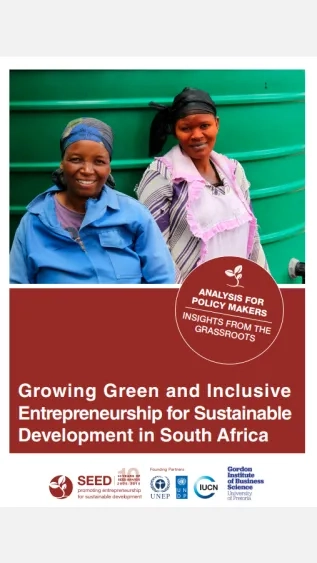
While South Africa is the second largest economy in Africa and has a relatively high GDP per capita, poverty, (youth) unemployment, inequality, food insecurity and environmental degradation are some of the greatest challenges faced by the country. Evidence shows that social and environmental enterprises that apply green and inclusive business models can play a significant role in addressing those challenges on the ground, and in turn, in achieving sustainable development. The National Sustainable Development Strategy highlighted the role of SMMEs, the informal sector and gender in a green economy in development. It is essential for policy makers to understand the impact of those enterprises and how their scale-up can be promoted through policy interventions. This report provides case studies in South Africa and highlights the social, economic and environmental impacts (Triple Bottom Line impacts) delivered by these enterprises, namely: