

This study assesses the potential contribution of public– private partnerships to Inclusive Green Growth, which is one of the main goals of Dutch development cooperation. Inclusive Green Growth – or ‘the economics of sustainable development’ – implies that growth should enhance welfare for both current (inclusive) and future (green) generations. This warrants attention for both ecological sustainability and the distribution of resource access. To analyse the potential of partnerships for reaching Inclusive Green Growth objectives, nine ongoing partnerships were selected and financed by the Dutch Directorate General for Foreign Trade and Development Cooperation. Using the academic literature on a) the requirements for effective Inclusive Green Growth strategies and b) the potential of public–private partnerships, an analytical framework was developed to be used for data collection (e.g. partnership documentation, interviews) and analysis.
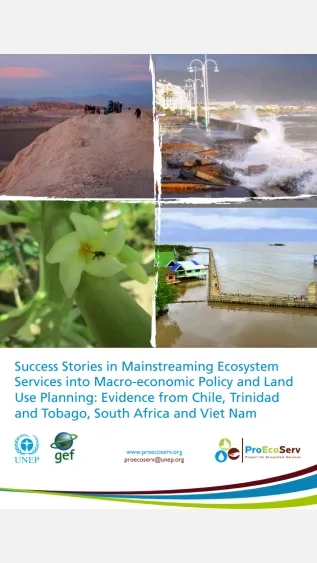
The 'ProEcoServe' project assessed ecosystem services such as the provision of soil retention, shoreline protection, carbon sequestration and pollination, identifying almost US$1 billion of benefits in the four pilot countries of Chile, Trinidad and Tobago, South Africa and Viet Nam. This final report includes the results of a four-year project to develop ecosystem assessment tools and products that decision makers can use to integrate the value of ecosystem services into policy, investment decisions and macro-economic models.
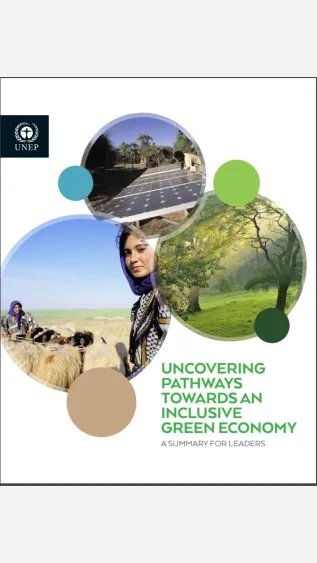
A green economy is one that results in improved human well-being and social equity, while significantly reducing environmental risks and ecological scarcities. In its simplest expression, a green economy can be thought of as one which is low carbon, resource efficient and socially inclusive. This report speaks to the multiple benefits – economic, health, security, social and environmental – that such an economic model can bring to humanity. An inclusive green economy (IGE) sees growth in income and employment from investments that reduce carbon emissions and pollution.
The IGE Narrative expands and deepens substantially the focus of UNEP's earlier work on green economy.
The ‘circular economy’ is gaining momentum as a concept in both academic and policy circles, and circular business models have been linked to significant economic benefits. This paper identifies barriers and enablers to adopting circular economy business practices, and presents key messages for policy-makers. It draws on input from a literature review, on discussions held in the context of the GreenEcoNet project and on an analysis of two SME circular business models.
The greening of the economy is a shared goal for advanced and less advanced economies alike, particularly where sustained and inclusive employment is an objective for policy-makers. However, the challenges of such greening, and the implications for employment and skills, vary across regions and countries. In the transition from high- to low-carbon production, labour market impacts are becoming more evident and changes will likely affect all workers. However, while these changes may be minor for the majority, they will be substantial for a small number of industries and professions. Preparation for the adjustments is essential to take full advantage of green growth opportunities. Policy-makers today are concerned with how to help their economies to move away from a low-level approach (low job quality, low environment protection, low skills), towards high skills, high productivity, and sustainable economies. This report provides evidence and policy analysis to foster an equitable shift to greener economies and more sustainable societies.
Adaptation presents developing countries with the ultimate dual challenge – building a rapidly evolving, sustainable economy within an environment increasingly altered by the impacts of climate change. To meet this challenge, adaptation policy must find balance and create synergy between the two, as climate resilience and economic resilience go hand in hand.
Economic development is associated with structural change, including an evolving sector composition, the emergence of new comparative advantages and skills, and shifts in consumer demand as a result of rising incomes – all of which has implications for adaptation. Existing attempts to adapt developing economies to climate change have nonetheless ignored these economic dynamics. Current approaches to adaptation often seek to preserve current structures, for example by protecting agricultural output, which neither acknowledges nor takes advantage of the fact that the status quo is evolving.