

The aim of this paper is to provide a critical review of the literature on the econometric analyses of firm-level determinants to eco-innovation. The review reveals some gaps in knowledge. First, an integrated theoretical framework which merges the insights from different approaches is missing. Second, the influence of some variables is still unsettled (demand-pull and cost-savings), whereas others have hardly been included in previous analyses (internal and international factors). Third, studies on the drivers to eco-innovation versus general innovation are relatively scarce with respect to those on the drivers to eco-innovation in general. Fourth, analyses of the relevance of different determinants to eco-innovation for distinct eco-innovator and eco-innovation types have largely been missing. Fifth, studies on middle-income and developing countries are still scarce. Sixth, the econometric analyses have relied on microeconometric methods based on cross-section data (mostly logit and probit models), whereas the use of panel data is virtually absent.
This publication is concerned with all policies that directly support the production or consumption of fossil fuels in OECD countries and in a selection of partner economies. It provides a useful complement to the online OECD database that identifies and estimates direct budgetary transfers and tax expenditures benefitting fossil fuels, and from which it derives summary results and indicators on support to fossil fuels, as well as policy recommendations. This report emphasises the problems that fossil-fuel subsidies cause in the context of broader policy efforts for mitigating greenhouse-gas emissions, and reviews the various reform initiatives that have already been taken at the international level (G-20, APEC, etc.). In addition, it presents the coverage, method and data sources used for constructing the online database, and further discusses caveats and data interpretation.
Cities are engines of economic growth and social change. About 85% of global GDP in 2015 was generated in cities. By 2050, two-thirds of the global population will live in urban areas. Compact, connected and efficient cities can generate stronger growth and job creation, alleviate poverty and reduce investment costs, as well as improve quality of life through lower air pollution and traffic congestion. Better, more resilient models of urban development are particularly critical for rapidly urbanizing cities in the developing world. International city networks, such as the C40 Cities Climate Leadership Group, Local Governments for Sustainability (ICLEI) and United Cities and Local Governments (UCLG), are scaling up the sharing of best practices and developing initiatives to facilitate new flows of finance, enabling more ambitious action on climate change. Altogether, low-carbon urban actions available today could generate a stream of savings in the period to 2050 with a current value of US$16.6 trillion.
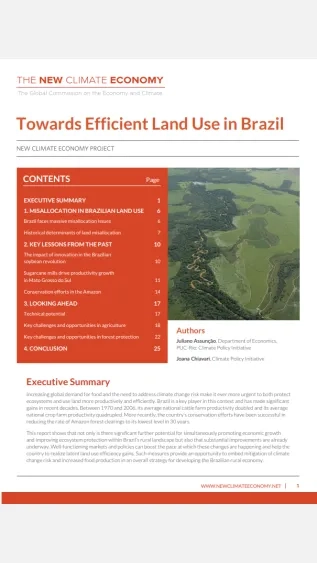
Increasing global demand for food and the need to address climate change risk make it ever more urgent to both protect ecosystems and use land more productively and efficiently. Brazil is a key player in this context and has made significant gains in recent decades. Between 1970 and 2006, its average national cattle farm productivity doubled and its average national crop farm productivity quadrupled. More recently, the country’s conservation efforts have been successful in reducing the rate of Amazon forest clearings to its lowest level in 30 years.
This report shows that not only is there significant further potential for simultaneously promoting economic growth and improving ecosystem protection within Brazil’s rural landscape but also that substantial improvements are already underway. Well-functioning markets and policies can boost the pace at which these changes are happening and help the country to realize latent land use efficiency gains. Such measures provide an opportunity to embed mitigation of climate change risk and increased food production in an overall strategy for developing the Brazilian rural economy.

Moving towards a ‘Circular Economy’ is an action that many world business leaders, policy makers, academics and NGOs argue is necessary in order to help solve global environmental and economic challenges. This report summarizes the findings of a project initiated by the Nordic Waste Prevention Group under the Nordic Council of Ministers to make the circular economy thinking more mainstream in the Nordic countries and thereby accelerate the development of circular economy in the Nordic region. In addition to this report, the project also included the organisation of a large multi-stakeholder workshop with participation of more than 60 actors relevant for the circular economy, which was held in in Copenhagen in April 2015.
In this report, there are 18 case examples of Nordic businesses which are part of the Nordic circular economy as well as short policy recommendations, which were suggested at the workshop.
This document presents lessons learned from over twenty Climate Public Expenditure and Institutional Reviews, a key tool for country decision-makers to improve their understanding of how and how much they are spending on their national climate change responses, and to identify public programmes with climate change objectives or co-benefits in which governments are investing.