
Climate change has financial implications for investors – presenting significant portfolio risks as well as new market opportunities. This paper explores the landscape of climate exposure and examines the strengths as well as some of the current limitations of ESG data, tools, and financial products.
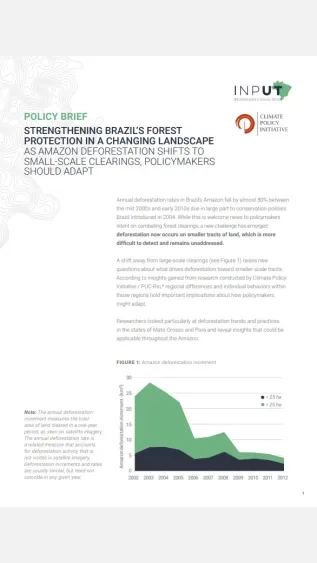
Annual deforestation rates in Brazil’s Amazon fell by almost 80% between 2004 and 2012 due in large part to conservation policies Brazil introduced in 2004. While this is welcome news to policymakers intent on combating forest clearings, a new challenge has emerged: deforestation now occurs on smaller tracts of land, which is more difficult to detect and remains unaddressed.

Central banks have wide ranging effects on the economy and society as a whole. Their decisions on monetary policy and sustainability are closely intertwined but the links between the mandates, objectives and instruments of central banks and a broad sustainability agenda are rarely reflected in policy debates.
This report focuses on monetary policy and its sustainability impacts in Bangladesh. It lays out areas for exploration and provides initial insights into Bangladesh’s economic development, its sustainability priorities as well as its financial system, and the relationship between these aspects and the country’s monetary policy. It also reviews the mandate, objectives, targets, and instruments of the country’s central bank, as well as the effectiveness of the transmission channels at its disposal. At the same time, it highlights that knowledge gaps on the topic remain significant.
This paper describes the challenge of modelling combined economic, ecological and financial systems and sets out a series of objectives for modelling the socio-economic transition towards sustainability. It highlights the modelling needs in relation to full employment, financial stability, and social equity under conditions of constrained resource consumption and ecological limits. It outlines the development of a dedicated system-dynamics model for describing Financial Assets and Liabilities in a Stock-Flow consistent Framework (FALSTAFF) and presents some hypothetical results calibrated for the Canadian economy. The selected scenarios illustrate the complex relationships between real and financial aspects of the macroeconomy and allow some initial tests on the financial viability of green investment.
Over 200 years ago, Adam Smith put forward the notion that individuals seeking to benefit themselves through trade were led as if by an invisible hand to a situation in which society as a whole could benefit. It can be argued, however, that social objectives such as sustainability and inclusiveness, do not emerge spontaneously through market forces. Such outcomes have to be designed through legal structures and institutions. In other words, for the invisible hand to operate, there needs to be a visible hand behind it.
By reviewing the financial inclusion experiments in South Africa and Kenya, this working paper provides some lessons for the design of the type of financial sector required for the transition from greed to green.
Policy-driven institutions such as national development banks (NDBs) and national green funds (NGFs) attract a growing interest to provide grants, credit-enhancement instruments or lend directly to project proponents in specific green sectors, with billions of dollars allocated by governments to support these interventions.
As part of ongoing efforts to better understand their comparative effectiveness to deepen national financial systems, the paper discusses the role of NGFs in catalysing institutional innovations and facilitating access to long-term affordable finance for green, low carbon and climate resilient investment. It argues that the key added value of NGFs might rest in their capacity to foster institutional innovations and partner with other financial and regulatory institutions to increase the diversity and depth of local financial markets in order to enhance the domestic supply of green finance.