
Over the last decade a consensus has been growing that accounting for natural capital and integrating that approach in governmental and business decision-making is an important pillar of global, national, regional, local and corporate conservation efforts. Accounting for natural capital aims to support halting biodiversity loss and avoiding the deterioration of ecosystems and the services they provide that underpin human well-being and economic prosperity. The Global Biodiversity Outlook (GBO-4) published in 2014 states that progress has been made in mapping and assessment of biodiversity, ecosystems and their services and in incorporation of their values into planning processes and strategies. However, there is still relatively little attention given to the integration of natural capital accounting into national reporting and accounting systems.

In the wake of the Copenhagen Accord in 2009 and amid frustration with the slow pace of the United Nations Framework Convention on Climate Change (UNFCCC) talks, a number of bilateral and plurilateral efforts and technology initiatives has been launched to deal with international climate policy. Bilateral efforts such as the November 2014 joint announcement between the United States (US) and China have provided welcome momentum. These minilateral efforts, together with the broader multilateral ones, constitute the emerging “regime complex” for climate change. In such a world, ambition in climate action must come from national governments as well as from international agreements. For promoting such ambition, key tools include market-based mechanisms that cap emissions of carbon dioxide and other global warming pollutants, and allow nations and firms that reduce emissions below capped levels to save, sell, and trade surplus units of allowable emissions. Such systems are in effect today in more than 50 countries, states, cities, and provinces where almost a billion people live.
In the debate on climate change, methods of producing products and energy are of paramount importance. While the product or the form of energy resulting may be the same, diverging production processes and methods of production may have a critical impact on climate change mitigation, and environmental and human concerns in general. Some may be detrimental, some may be beneficial. They vary from each other, notwithstanding that the final products cannot be distinguished from each other. This paper explores the extent to which renewable energy and non-renewable energy, in particular based on fossil fuels, may be regulated, labelled, or taxed differently, or whether the likeness of the product prohibits doing so in international trade law relating to production and process methods (PPMs). In doing so, the paper mainly focuses on the production of electricity from fossil fuels (coal, oil, and gas), atomic energy, and renewable energy (hydropower, thermal power, wind, solar and tidal energy, and biomass).
The long-standing reaction of the trade community to attempts to embroil trade law and policy in the resolution of the climate change issue has been to say, “Solve your own problems on the basis of your own agreed multilateral instruments, and when you have, if there are interfaces or overlaps between your regime and the trade regime, we will find means of resolving them constructively.” While this is understandable, it is rendered impractical, first by that an effective set of agreed international climate mitigation policies, which stand a chance of allowing the achievement of the agreed objectives, is probably as far away now as it has ever been; and second by that the development of domestic politics in both developed and developing countries has revealed trade to be in principle a major source of carbon and political leakage from any aggressive mitigation regime, and thus a serious constraint on national and international mitigation plans.
Green development emphasizes co-development between economic and environmental dimensions, and is a people-centered sustainable development approach. Western China demands green development, and international experience could provide necessary, unique and important help and support for Western China to achieve its green development goals. This paper has made a comprehensive overall review and analysis of international experience in green development policy and its implementation, in particular, OECD countries’ (mostly Australia and Canada) experience have been analyzed following the major policy foci defined by the Task Force on Strategy and Policies on Environment and Development in Western China initiated by China Council for International Cooperation on Environment and Development (CCICED). Data and information were gathered from the field surveys and investigations, expert meetings, as well as literature review. The main sections include policy framework and road map establishment, implementation and performance assessment, co-development between economic development and environmental protection, as well as green employment and poverty alleviation.
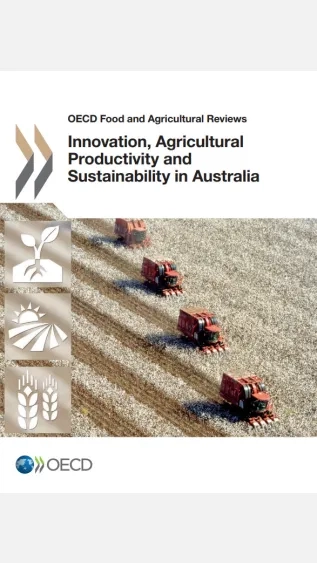
This review Innovation, Agricultural Productivity and Sustainability in Australia examines Australia’s policy conditions surrounding business and allowing innovation in the agriculture and food sectors for increased productivity and environmental sustainability.