

This paper has been developed to inform discussions on smart infrastructure development and financing as part of the sustainable development goals (SDGs) and climate processes in 2015. The article is designed to respond to five questions. First, why is a major increase in investments in better infrastructure essential to both development and climate goals? Second, what is holding back this investment? Third, how can the deployment of private capital into infrastructure investment be doubled? Fourth, what is the distinctive role of development banks in closing the infrastructure investment and financing gap? Fifth, how can official development assistance and climate finance reinforce each other?
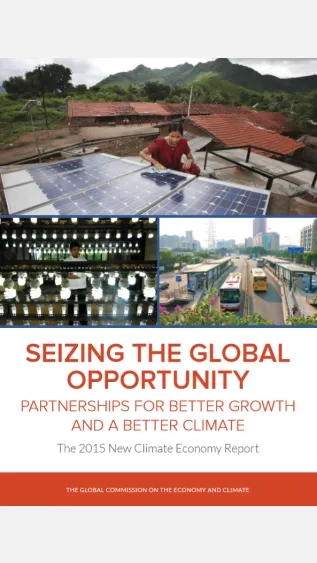
This report, from the New Climate Economy, provides 10 practical recommendations to boost economic growth and reduce climate risk. These recommendations could deliver up to 96% of the emissions reductions required by 2030 to keep our planet on a pathway to keep global warming under 2 degrees celsius. And these are actions that would also deliver multiple economic benefits.
The report calls for stronger cooperation between governments, businesses, investors, cities and communities to drive economic growth in the emerging low-carbon economy. International and multistakeholder cooperation can scale up technological change, expand markets, reduce costs, address concerns about international competitiveness, spread best practice and increase the flows of finance.
This report produced in co-operation between the Organisation for Economic Co-operation and Development (OECD), the International Energy Agency (IEA), the International Transport Forum (ITF) and the Nuclear Energy Agency (NEA) identifies the misalignments between climate change objectives and policy and regulatory frameworks across a range of policy domains (investment, taxation, innovation and skills, trade, and adaptation) and activities at the heart of climate policy (electricity, urban mobility and rural land use).
Outside of countries’ core climate policies, many of the regulatory features of today’s economies have been built around the availability of fossil fuels and without any regard for the greenhouse gas emissions stemming from human activities. This report makes a diagnosis of these contradictions and points to means of solving them to support a more effective transition of all countries to a low-carbon economy.
An assessment of Integration and Implementation of Environment and Climate Change Activities into Development Sectors Plans and Programmes in Rwanda conducted by the Rwanda Environment Management Authority (REMA) through the Department of Environmental Education and Mainstreaming (DEEM) with the support of the Poverty-Environment Initiative (PEI).
The OECD Principles on Water Governance are intended to contribute to improving the “Water Governance Cycle”—from policy design to implementation.
This report, Delivering the Circular Economy: A toolkit for policymakers, provides an actionable toolkit for policymakerswho wish to embark on a circular economy transformation.