

During the 2008 financial crisis, central banks deployed unconventional means to rescue failing banks and insulate economies from depression. Their asset purchases have had strong social impacts, but traditionally, central banks have not explicitly factored social objectives into their decisions or evaluated their impacts beyond the narrow monetary domain.
In this paper Andrew Sheng argues that central banks, when purchasing financial assets, should consider selecting assets that will promote sustainability, including climate change mitigation and adaptation. Social impact investing he argues is consistent with a central bank’s mandate to maintain price stability. They could incentivize bankers and asset managers to invest in, or lend to, climate mitigation activities and low-emission growth.
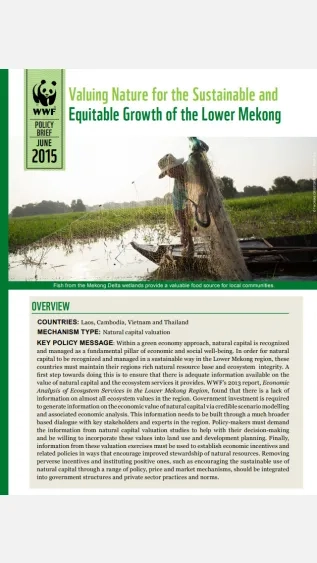
This case study Valuing Nature for the Sustainable and Equitable Growth of the Lower Mekong builds off the 2013 WWF report ‘Economic Analysis of Ecosystem Services in the Lower Mekong Region’ which draws on the best available published data and techniques to quantify the economic value of ecosystems in Cambodia, Laos, Thailand and Vietnam and the costs and benefits of managing them sustainably.
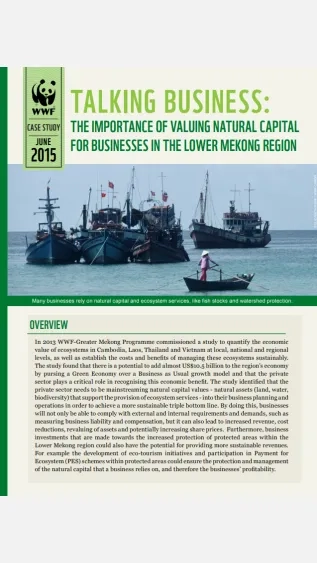
This case study Talking Business: The Importance of Valuing Natural Capital for Businesses in the Lower Mekong highlights the benefits and opportunities of valuing and mainstreaming natural capital into business operations, and the potential for enhancing the financial bottom line for those businesses investing or operating in the Lower Mekong countries.
This case study reflects on a WWF Green Economy Modelling report conducted in 2013 ‘Green Economy Modelling of Ecosystem Services in the Dawna Tenasserim Landscape (DTL) along the ‘Road to Dawei’, which looked specifically at the sustainable transport infrastructure options within this landscape which straddles both Thailand and Myanmar. The case study provides a summary of the analysis and results from the report, including the projections generated up to 2035 that analyze the short, medium and longer-term consequences of road construction and from these, how a green economy approach over a business as usual approach is not only the most sustainable choice, but also the more economical choice in the long term, that helps healthy economies and societies to grow.
Eco-innovation globally emerged as an effort to implement sustainable development. States and firms established and implemented policies and strategies for eco-innovation as one route to achieving sustainable development. Eco-innovation has been facilitated in developed countries, specifically OECD members and European countries, through action plans. Recently, eco-innovation policies have emerged in developing countries. Thus, this study analyzes eco-innovation policies in Asian countries. Policies related to eco-innovation in 17 Asian countries were investigated using policy instrument categories. National policies for eco-innovation were interpreted and compared with development stage classifications. The results indicate that there are similar and different policy approaches to eco-innovation in Asian countries. Given the balance between a technology push (supply side) and a market pull (demand side) in policy instruments for eco-innovation, 17 countries were identified by four categories: leaders, followers, loungers, and laggards. The results provide insight for designing national strategies for eco-innovation in Asia’s developing countries.
Unemployment is a major challenge for Europe. The crisis has led to budget cuts and it has made the socio-economic integration of people who have low educational attainment, low skills, a history of longterm unemployment and who are vulnerable even more difficult. At the same time, environmental degradation, climate change and unsustainable development are amongst the most serious threats that our society has to address; the environmental and health costs often outweighing the gains from economic activity.