
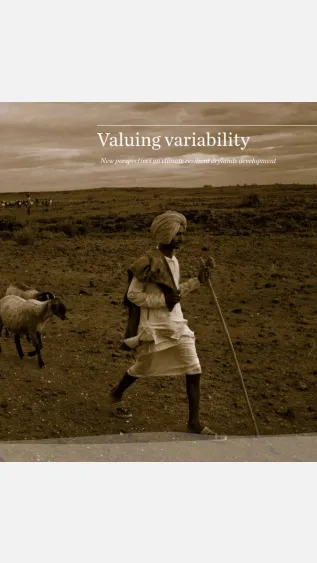
This book Valuing variability: new perspectives on climate resilient drylands development argues that improving agricultural productivity in dryland environments is possible by working with climatic uncertainty rather than seeking to control it – a view that runs contrary to decade of development practice in arid and semi-arid lands.
The OECD Environmental Performance Review Programme provides independent assessments of countries’ progress in achieving their domestic and international environmental policy commitments, together with policy relevant recommendations. They are conducted to promote peer learning, to enhance governments’ accountability to each other and to the public, and to improve countries’ environmental performance, individually and collectively. The reviews are supported by a broad range of economic and environmental data. Each cycle of the Environmental Performance Reviews covers all OECD member countries and selected partner countries.
This report is the third OECD review of Poland’s environmental performance. It evaluates progress towards sustainable development and green growth, with a focus on forestry and biodiversity, as well as waste and materials management.
Private sector hydropower projects are driven primarily by returns on equity investment balanced by perceptions of risk. This can lead to concerns that such projects may overlook environmental and social (E&S) issues that are fundamental to sustainability.
But the two need not be mutually exclusive. We present the business case for adopting the E&S risk management tools developed by the international public finance sector: that better understanding and management of risks can protect expected financial returns and the developer’s reputation. We suggest that bilateral donors support implementation of these tools through a combination of grants and risk management guarantees. In this way, public funds support public goods and local development goals, while private sector funds generate a return on private capital, together furthering sustainable development and growing the global green economy.
The Coruh/Chorokhi river system is of great economic importance to both Turkey and Georgia because of its largely undeveloped but economically exploitable potential for hydropower. On both sides of the border a large number of hydropower projects are being implemented unilaterally in which private investors play the key role, following liberalisation of the energy sectors in Turkey and Georgia. This has been promoted in both countries, despite the resulting social and environmental costs, particularly in Turkey.
Negative effects – i.e., the changes in sedimentation and the river flow regimes – moving from upstream interventions in Turkey to downstream Georgia – have still not been resolved, and they will put electricity generation in Georgia at risk when the hydroelectricity plants start operating. This article explores regional disputes and the degree of cooperation that exists, and analyses the effect that the efforts of relevant actors to establish regional electricity trading are having on the current problems. The creation of a regional electricity market seems to be opening up a new avenue for cooperation also on water.
This document elaborated by the Global Green Growth Institute (GGGI) and the German Development Institute (DIE) conducts an in-depth exploration of the statistics of the National Household Surveys (ENAHO) 2004-2013 and disaggregates essential information on the conditions of the populations that depend on the forest for their welfare.