
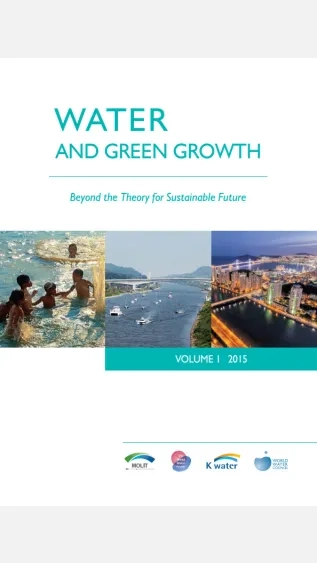
This report was launched at the 7th World Water Forum in Daegu, Gyeongbuk, Republic of Korea. It presents the research conducted from 2011 - 2014, a new theoretical approach, a revised analytical framework and recommendations for policy makers to begin the process of implementing water and green growth strategies. The report provides a recap of the history and rationale behind the development of the Water and Green Growth Project and concept. The analytical framework used in the report has been developed through numerous discussions between experts in various fields and encompasses strategic, institutional, and practical approaches.

The Europe 2020 Strategy has identified the key goal of smart, more inclusive and sustainable growth. In this direction, redirecting firms’ innovation activities towards ecological targets without hampering their competitiveness is of paramount importance. The double externality issue related to environmental innovations makes the policy intervention crucial in order to avoid sub-optimal commitment of resources to the innovation process and ensure the reduction of polluting agents emissions.
This report develops an analytical framework that assesses the macroeconomic, environmental and distributional consequences of energy subsidy reforms. The framework is applied to the case of Indonesia to study the consequences in this country of a gradual phase out of all energy consumption subsidies between 2012 and 2020. The energy subsidy estimates used as inputs to this modelling analysis are those calculated by the International Energy Agency, using a synthetic indicator known as "price gaps". The analysis relies on simulations made with an extended version of the OECD’s ENV-Linkages model. The phase out of energy consumption subsidies was simulated under three stylised redistribution schemes: direct payment on a per household basis, support to labour incomes, and subsidies on food products.
This report presents key findings on chemical leasing—a business model that decouples the supplier’s income from volume sold, as the customer pays for the results the chemical use generates, not the volume of chemicals used.
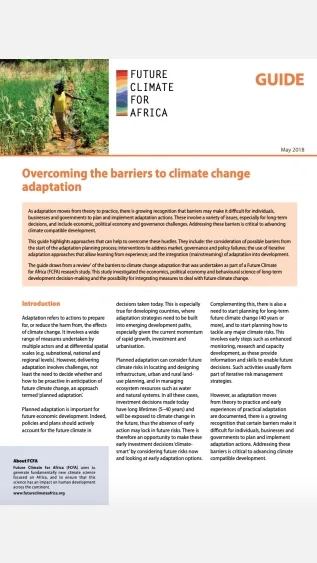
This paper highlights approaches that can help to prepare for, or reduce the harm from, the effects of climate change. It touches on the economics, political economy, and behavioral science of long-term development decision-making and the possibility for integrating measures to deal with future climate change.
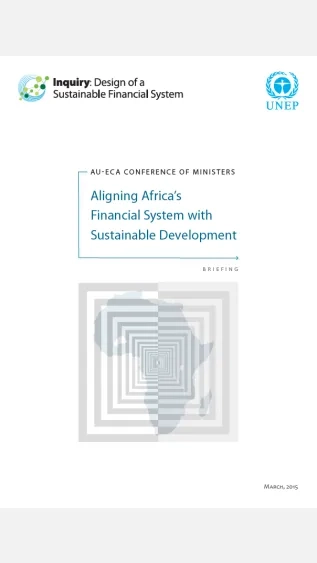
Adequate, appropriate finance is crucial for Africa’s sustainable development. Its availability depends on African countries developing financial systems that can effectively draw on and deploy to best use domestic and international, private and public sources. With the growing importance, in particular, of both domestic sources of finance, and private investment (both domestic and international), it is critically important that Africa’s financial and capital markets develop in ways that will promote sustainable development on the continent.
Aligning a financial system with sustainable development does not happen automatically. The increasing scale and sophistication of Africa’s financial system alone will not achieve it. Indeed, the international evidence amply demonstrates that financial and capital markets can — and often do — become detached and fail to adequately serve the long-term needs of inclusive sustainable development.