
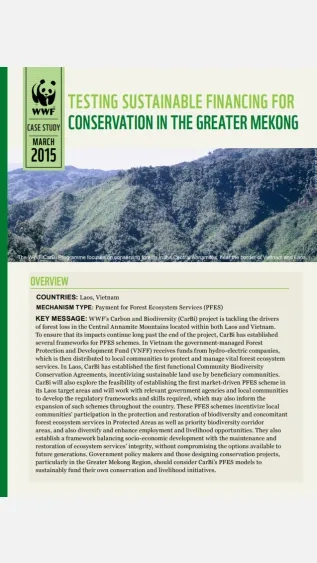
WWF’s Carbon and Biodiversity (CarBi) project is tackling the drivers of forest loss in the Central Annamite Mountains located within both Laos and Vietnam, one of the world’s biodiversity hot spots. This case study outlines the efforts of the CarBi project of developing sustainable financing mechanisms, specifically Payments for Forest Environmental Services (PFES) schemes, to support conservation interventions beyond the project lifetime. It concludes with a number of recommendations for the establishment of similar financing mechanisms throughout developing nations.

This report addresses investment in sustainable urban infrastructure and provides an overview of financial instruments that are commonly used to finance infrastructure development. It analyses their potential to support the transition towards sustainable infrastructure, with a primary focus on energy efficiency and renewable energy at city level. Cities are faced with the huge challenge of providing infrastructure that meets the needs of a rising urban population with limited public resources. Cities already account for over 70% of global greenhouse gas emissions and energy consumption and face rising climate change-related risks. The way cities develop, particularly large and fast-growing cities in developing and emerging economies, is likely to have profound and long-term implications for both climate change and the global economy. Decisions and investments in urban infrastructure must be leveraged to achieve sustainable economic growth within the carrying capacity of the planet’s systems and resources.
This article explores the regional disputes on the shared river and the degree of cooperation that exists. Despite prevailing negative impacts – i.e., the changes in sedimentation and the river flow regimes – caused by upstream dam construction in Turkey and affecting downstream Georgia, the article finds that the creation of a regional electricity market seems to be opening up a new avenue for cooperation between Turkey and Georgia also on the so far unilaterally utilized river.
The electricity system in Turkey faces three challenges. First, demand for electricity is growing as economic growth brings increased energy usage. Second, as the electricity supply expands to keep pace with demand there is the need to ensure that electricity prices remain affordable. Third, as energy and electricity are at the heart of modern economies, energy security is critical for the electricity sector. To balance the competing demands of demand growth, affordability and energy security, policy must seek to create a framework that promotes technologies and projects that meet these needs and deliver sustainable development.
The study gives an overview of the international debate on issues related to green jobs and the green economy and the associated definitions, concepts and measurement approaches. The study provides an overview of the central instruments for promoting a green economy and employment in it and integrates them in an overall taxanomy. The authors discuss the role of the accompanying employment and labour market policy instruments and present the most important methods for identifying and assessing the employment impacts of a greening of the economy. On that basis, a series of recommendations for action are formulated to promote employment within the framework of green economy strategies for the context of development cooperation.
There is an increasing focus on the role that public and private resources can play in supporting activities that reduce forest loss as part of wider efforts to address climate change, and ensure sustainable development.