
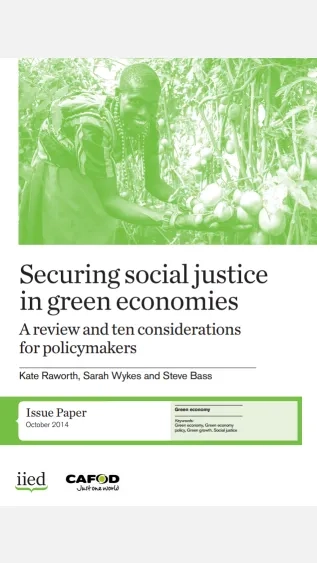
‘Green economy’ and ‘green growth’ policymaking is moving to the centre of many national development strategies. Green policies should enable countries to manage their natural resources more sustainably and efficiently, diversify into new green markets and secure the environmental foundations of development. But do they automatically increase social justice?
Green and just development requires two key ingredients: integrated policymaking and a holistic outcome framework combining environmental, social and economic objectives. Focusing on developing countries, this paper draws on learning from national case studies and international analyses. It concludes with ten critical considerations for shaping green and just national strategies and policies.

The authors document three remarkable features of the Opower program, in which social comparison-based home energy reports are repeatedly mailed to more than six million households nationwide. First, initial reports cause high-frequency "action and backsliding," but these cycles attenuate over time. Second, if reports are discontinued after two years, effects are relatively persistent, decaying at 10-20 percent per year. Third, consumers are slow to habituate: they continue to respond to repeated treatment even after two years. The authors show that the previous conservative assumptions about post-intervention persistence had dramatically understated cost effectiveness and illustrate how empirical estimates can optimize program design.
The policy summary for this paper is available here.
This year’s report includes an in-depth look at energy efficiency developments in the transport sector and in finance. Huge new waves of demand for mobility are emerging in OECD non‑member economies, bringing with them the challenges of pollution and congestion already faced in OECD countries. Fuel-economy standards and other policies are expected to help shape the market for more energy-efficient vehicles in the years to come. In financial markets, energy efficiency is becoming an important segment in its own right, aided by a growing range of financial products. This report documents the growing scale and diversity of energy efficiency products and actors.
Finally, this report reviews national energy efficiency market developments in various jurisdictions around the world, including Canada, China, the European Union, India and Italy. These case studies provide snapshots of specific energy efficiency sub-markets, and insights into how these markets may evolve in the coming years.
Green infrastructure and integrated transportation are the two dominant green best practices that cities around the world are implementing and that research related to the climate change impacts of extreme temperatures and air pollution advocate for. Are these policies enough to address climate change and its impacts on human health, now and in the future? The answer to this question depends on whether cities choose to continue with the same status quo policies or develop new policies in the light of climate change.
This report summarises the findings of a project on green entrepreneurship in Tunisia financed by German international cooperation. The two-year project (2013/2014) was implemented by the Deutsche Gesellschaft für internationale Zusammenarbeit (GIZ) within the framework of the programme for entrepreneurship and innovation (PAEI). A series of training courses were offered to a selected group of potential multipliers of the green business concept: local consultants, support organisations and college teachers, all already active in the promotion of entrepreneurship in general. They were trained by national and internal consultants. Over the two years, they built a strong network of promoters of green entrepreneurship and came up with an action plan for the time after the end of the German funded project.
This chapter describes a range of financial instruments increasingly used by public development finance providers to mobilise resources for investment in developing countries. It focuses on the functioning of pooling mechanisms, guarantees and equity investments, and their potential to mobilise private investment in key sectors such as infrastructure.This chapter also includes two opinion pieces. The first is by Pierre Jacquet, President of the Global Development Network, on how official development assistance should be used to enhance risk sharing between the private and public sectors. The second is by Owen Barder of the Center for Global Development on stimulating private investment by ensuring genuine returns for success.