
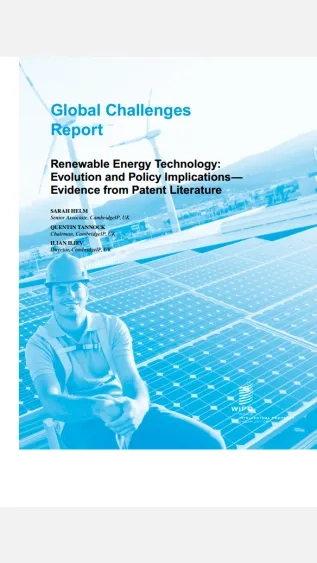
This Global Challenges Report analyzes the patent landscapes of four Climate Change Mitigation Technologies (CCMTs) to inform policy discussions by providing empirical evidence of innovation trends and technology ownership. The four CCMTs are biofuels, solar thermal, solar photovoltaic (PV) and wind energy. A broad market analysis of renewables and their policy frameworks are discussed in Section 2, followed by a scope and methodology section. The individual patent landscape analysis for each of the CCMTs is given in Sections 4 to 7, identifying and analyzing the range of patent activity, patent filings trends, top technology owners, patent concentrations, and market trends.
Each of these sections also includes anecdotal case studies to illustrate various features of the technology marketplaces and to situate the patent data into the context of market activity and business strategies. The report includes data from 1975-2011 and compares the 1975-2005 period to the 2006-2011 period.
A companion Global Challenges Brief also discusses key implications and considerations for policy and policymakers.

Failures at Tailings Management Facilities (TMFs) may lead to major environmental catastrophes with devastating effects on humans and the environment both within and across countries, as demonstrated by major past accidents in the UNECE region, such as the dam break of a tailings pond at a mining
This report World Investment Report 2014 provides valuable analysis that can inform global discussions on how to accelerate progress toward the Millennium Development Goals and shape a long-range vision for a more sustainable future beyond 2015.
This working paper was produced for the early stage of the UN Environment Inquiry to provide an initial overview of the areas where the financial sector can have an impact on moving the green economy forward and the extent to which green financial policy is already actively being practised.
Delivering the Green Economy through Financial Policy is focused on financial regulation and the instruments of financial policy that apply to the financial sector. The financial sector plays a valuable financial intermediation role and is the source of capital needed for economic growth, but in a market economy, capital allocations will be dictated by risk-return considerations in the real sector. The financial sector can react to real sector opportunities, but it generally cannot create such opportunities in any sustained manner. The paper maps out the financial regulatory landscape and lays out the functions that different Financial Initiatives fulfil. It looks at regulatory mechanisms that operate via financial markets to influence investment behaviour and concludes with some open questions that warrant discussion and further study.
This Economics of Land Degradation Initiative: Practitioner’s Guide reaches out to provide practitioners and decision-makers with the skills necessary to make an economic case for preventing or reversing land degradation and to adopt more sustainable land management options.
This report is a Quick guide to the report The Value of Land - Prosperous lands and positive rewards through sustainable land management.