

The Green jobs mapping study was carried out at the end of 2013 as part of the inception phase of Partnership for Action on Green Economy (PAGE) in Mongolia. The Green Jobs Mapping Study of Mongolia at hand gives an overview on green jobs in Mongolia.
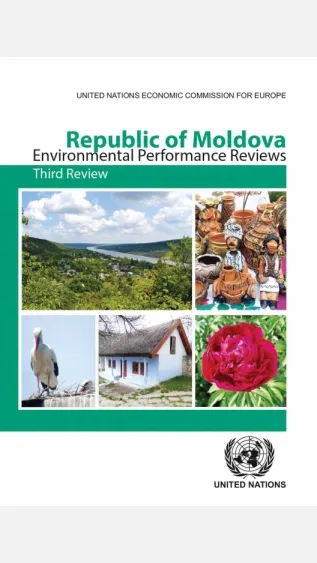
The Third Environmental Performance Review of the Republic of Moldova takes stock of the progress made by the Republic of Moldova in the management of its environment since the country was reviewed in 2005 for the second time.

This paper is primarily a critical analysis of the social sustainability assumptions of green growth. It examines the extent to which the overall approach and assumptions inherent in the green growth model allow it to adequately address key social sustainability underpinnings of sustainable development e.g. multi-dimensional poverty, inequality and social justice. In so doing, the potential for green growth to deliver in important ways for poor and marginalized individuals is also considered. The false dichotomy that may unintentionally be created between economic efficiency and social equity considerations is investigated in further depth. Employing a social justice lens informed by the existing socio-environmental and socio-ecological literature, explicit and inexplicit synergies, trade-offs and conflicts are explored. A largely theoretical review, it will also be complemented by analysis of one of the more well-known sustainable development public policy responses to-date: biofuels. Advancing a more multidimensional theoretical approach to the longstanding problem of sustainable development i.e.
Because the effectiveness of payment for ecosystem services (PES) programs depends on landowners’ engagement, understanding the relationship between the type of payment and participation is a key issue. This paper reports on a choice experiment that quantifies landowners’ preferences for cash and educational in-kind payment. The main results indicate a positive correlation between participation in a PES contract and the magnitude of the cash payment, while participation seems uncorrelated with the magnitude of the educational in-kind payment. In addition, we investigate the mix of payment types and heterogeneity in preferences, which can help policymakers design strategies to increase participation.
This report seeks to provide practitioners with the tools and information needed to respond to the public expenditure policy and management challenges arising from climate change. It is a series of notes and supporting materials written as a first step towards consolidating current research and international experience, identifying emerging practice and providing practical and applicable guidance for staff of central finance agencies, development agencies, environmental agencies and other international organizations working on climate change issues. In addition to emphasizing the importance of strengthening national systems throughout, the Sourcebook focuses on the specific public expenditure policy and management challenges posed by climate change, such as decision-making in the face of uncertain future climate conditions, expenditure planning for extreme weather and climate events, the lack of agreed budget definition and classification of climate change activities.
This report reviews in a systematic manner the skills available and skills required for the introduction and deployment of green technologies in the cement industry in Indonesia. It reviews the existing systems in place for developing a skilled labour force and proposes some specific recommendations on how to adapt to evolving demands. This report builds on continuing efforts made by the International Labour Organization in reviewing the need for skills for green jobs and the development of sector-based analysis for advancing global research work on promoting decent work. The report provides evidence and additional new information to support a tripartite dialogue on the best approach for promoting access to skills for green jobs and the greening of existing jobs in the Indonesian cement industry to create decent, productive work and to improve the environmental sustainability and competitiveness of the sector.