

The strengthening of the link between environment and economy is a key challenge faced by the Arab countries. By integrating the environment into the economic policy and working towards green growth at a national and regional level, Arab countries will be able to progress in economic growth, jobs creation, social equity and sustainability of natural resources. This paper endeavors to deepen this argumentation, and highlights both the benefits that could be reaped by Arab countries and the priorities in the implementation of a green growth strategy.
The Fifth Assessment Report from the Intergovernmental Panel on Climate Change is the most up-to-date, comprehensive and relevant analysis of our changing climate. Urban centres account for more than half of the world's population, most of its economic activity and the majority of energy-related emissions. This briefing explores the roles cities will play in the fight against climate change.
Climate-related disasters have inflicted increasingly high losses on developing countries, and with climate change, these losses are likely to worsen. Improving country resilience against climate risks is therefore vital for achieving poverty reduction and economic development goals.
This report discusses the current state of knowledge on how to build climate resilience in developing countries. It argues that climate-resilient development requires moving beyond the climate-proofing of existing development pathways, to consider economic development objectives and resilience priorities in parallel. Achieving this will require political vision and a clear understanding of the relation between climate and development, as well as an adapted institutional set-up, financing arrangements, and progress monitoring and evaluation. The report also discusses two priorities for climate-resilient development: disaster risk management and the involvement of the private sector.
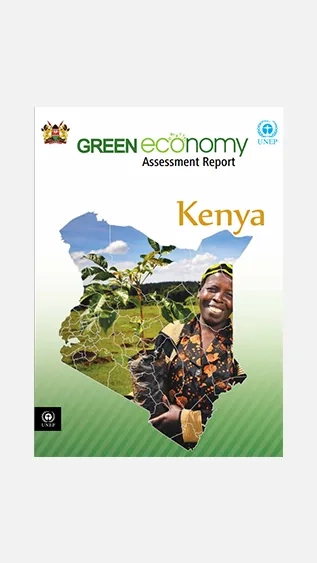
Kenya has one of the most dynamic economies in Africa, yet it is facing a number of pressing economic, environmental and social challenges. In recent years, Kenya has adopted several green economy-related approaches and policies, which include implementing renewable energy feed-in tariffs in 2008, embedding sustainable natural resource utilization into its 2010 Constitution and mainstreaming green economy in its Second Medium Term Plan (2013-2017).
In this context, the Ministry of Environment, Water and Natural Resources, in partnership with UNEP, commissioned a study to assess the economic benefits and challenges of investing in priority economic sectors in support of Kenya’s transition to a green economy. The study examines investments under “business-as-usual” (BAU) compared to green economy scenarios in four key sectors that are critical for the country’s green growth, namely: agriculture, energy, manufacturing and transport.
This chapter in Ensuring Good Global Governance through Trade presents an analysis of sustainable development goals in the context of two mega-regional trade agreements: the Transatlantic Trade and Investment Partnership (TTIP) and the Trans-Pacific Partnership (TPP). These preferential trade agreements present a more efficient vehicle by which to promote sustainable development than the multilateral trading platform. The chapter discusses sustainable development and energy within the proposed TTIP. The TTIP aims to further economic growth, investment and trade between the United States and the European Union (EU), and could potentially have a very large impact as the U.S.-EU trade and investment flows are sizeable and a critical element in global commerce. The chapter argues that the TTIP has the potential to foster sustainable development, energy efficiency, and energy security.
'Inclusive green growth' is no longer just a buzz term. It is shaping donor priorities, influencing national development plans and attracting investment. Yet inclusive green growth policies commonly promoted by international institutions make little, if any, reference to informal economies - which are expanding in all parts of the world in response to changes in our formal economies - and which cater for the world's poor. What does Green Economy mean in the context of informal markets where the world's poorest and most vulnerable people produce and trade? Does 'greening' necessitate formalisation, or can it happen through people's own actions?