
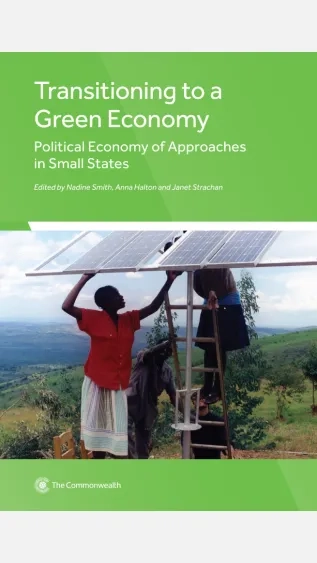
While the term ‘green economy’ has been widely used at the international level, very little information exists about what the concept looks like in practice. It remains to be explored what policies are required, and what the challenges of implementation at national level are.
This book contains case studies from eight small states that have committed publicly to greening their economies: Botswana, Grenada, Guyana, Jamaica, Mauritius, Nauru, Samoa and Seychelles. It provides insights into the success of various initiatives and highlights how small states themselves are making practical progress on a green economy approach.

Global interest in the ‘green economy’ has heightened since 2008, and this article contributes to these discussions by elaborating on (a) four alternative, and sometimes competing, discourses of the green economy, and (b) the particular politics of the green economy in South Africa. Most research on the green economy tends to focus on European and North American countries, however in the context of a changing global economy and the ‘rise of the South’ the politics of the green economy in countries like South Africa is of increasing importance. South Africa faces many challenges in pursuing a transition to a more sustainable development path, yet has been cited as a global green economy leader. This article argues that this is related to the particular discourse of ‘green growth’ which is dominant in South Africa, and proposes two significant lines of critique of this discourse. The first cautions that commitment to the green economy may not be particularly deep-rooted, sustained or coherent; and the second highlights some of the more troubling political implications of the type of green growth advocated, even if it were to be pursued with more determination.
Payments for Ecosystem Services (PES) describes the situation where the user of an environmental service, such as water purification, pays the landowners who provide that service. For PES to exist, there must be a clearly defined user and supplier, as well as a number of other necessary conditions, which are defined in this document using a summary of current sources. Particular attention is paid to how these conditions currently obtain within the UNECE region. The range of forest environment services is explored through fourteen detailed case studies, which examine best practice in promoting PES. Political and public relations implications of PES are discussed at length, and recommendations include the need for clarity about where PES may be a useful tool in moving towards a green economy and where other methods may be more appropriate.
The concept of the Sustainable Future was generated in global dialogues; more recently, it has started to transfer to policy making. The paper seeks to discuss how foresight is used to understand the implications of global changes, focusing on the role of green economy strategies in fostering societal, economic progress and environmental conservation. In particular, the use of green economy indicators is reviewed, focusing on the measuring frameworks proposed by different organizations. Finally, an integrated approach is proposed to carry out a systemic and cross-sectoral assessment of key policy instruments aimed at facilitating the transition to a more sustainable future.
In October 2013, Ontario Premier Kathleen Wynne announced her government’s plan to issue green bonds. The Government of Ontario will be the first province in Canada to issue green bonds, but not the first government agency in Canada to do so. Export Development Canada issued a green bond in January 2014, and TransLink, Metro Vancouver’s regional transportation authority, has issued very similar bonds without adding the ‘green’ label. The Ontario government plans to use the bond proceeds for investment in "transit and other environmentally friendly infrastructure projects across the province." At press time, the Government of Ontario had not released further details regarding the specific allocation of the bonds’ proceeds.
Green skills, that is, skills needed in a low-carbon economy, will be required in all sectors and at all levels in the workforce as emerging economic activities create new (or renewed) occupations. Structural changes will realign sectors that are likely to decline as a result of the greening of the economy and workers will need to be retrained accordingly. This report outlines the role of skills and training policies as an important component of the ecological transformation process.