

This paper sketches the profile of the changing ‘green growth/economy architecture’ at the global, national, corporate and local levels. It finds that the project of ‘green growth’ continues to gain political momentum, attract new investment and draw in new players. Secondly, it describes some of the frontiers of the green economy discussions. In particular, it shows how issues of equity and social inclusion are no longer fringe moral debates – but those of mainstream economics and politics. Thirdly, it questions if the emerging ‘green growth/economy architecture’ is capable of delivering more equitable outcomes and restoring our environment. Finally, the paper points to some of the key changes in order for the green economy to evolve, mature and supersede the brown economy.
Fossil-fuel subsidies matter: for sustainable development; for government budgets; for the poor; for women; and for the environment. Subsidies amounted to $544 billion (2012) and are largest in MENA and Southeast Asia. Reforming and redirecting subsidies will be an important piece of the jigsaw if we are to solve the climate change puzzle. Savings enable governments to manage deficits; could be redirected at building energy networks; or targeted at social spending. This paper finds opportunities for Nordic countries to increase cooperation around reform and makes specific recommendations. The paper is part of the Nordic Prime Ministers' overall green growth initiative.
This paper explains why the Republic of Korea adopted green growth as a new national development strategy and details how it has been implemented by the government. The author suggests that Korea adopted green growth as a new economic growth paradigm to create new growth engines and jobs through green technology and the greening of industries. The green growth path was seen as essential not just for sustainable economic growth, but also to improve the quality of life and well-being of the Korean people. The paper also details how green growth was implemented by the Korean government; draws together key outcomes to date from Korea’s green growth policy; and suggests lessons learnt which could be applied to other countries.
This paper is the first from the Korea Green Growth Partnership and World Bank's new "Green Growth in Action, Knoweldge Note Series".
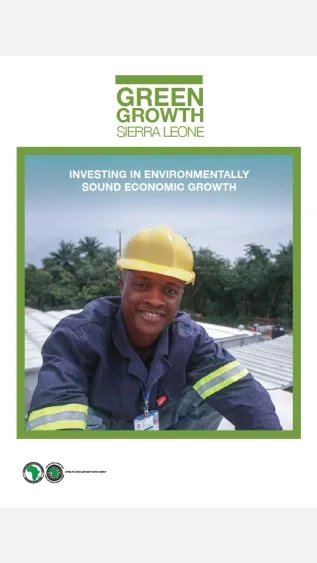
This booklet summarizes the green investment opportunities within Sierra Leone’s recently launched 2013-2018 Poverty Reduction Strategy Paper, known as the Agenda for Prosperity. A number of the Agenda’s planned green interventions are currently unfunded: the overall cost of implementing the plan is an estimated US $5.75 billion with a funding gap of US $2.1 billion. In light of this, the AfDB has created this booklet to help the government attract investment for its green growth activities.
The European Commission, in co-operation with the European Platform for Biodiversity Research Strategy (EPBRS), organised on 12 November 2014 an e-consultation as part of an ongoing multi-stakeholder dialogue that will contribute to framing a comprehensive EU Research & Innovation policy framework for Nature-based solutions. This report presents the main findings across the topical discussions of the e-consultation have been summarized, also in the form of word clouds and topic clusters.
Towards the Circular Economy: Accelerating the scale-up across global supply chains, finds that over US$1 trillion a year could be generated by 2025 for the global economy and 100,000 new jobs created for the next five years if companies focused on encouraging the build-up of circular supply chains to increase the rate of recycling, reuse and remanufacture.