

The marginality concept calls for the integration of poverty concepts with those of social exclusion, geography, and ecology. The difficulties in reaching people at the margins of systems are explained by a set of distances, (i.e., physical distances such as being located in remote or harsh environments), social distances (being excluded, discriminated against, or not having rights or access to services or opportunities), but may also be related to technological and institutional infrastructure deficiencies. A review of policies intended to reduce marginality suggests that none of the marginality determinants need to be accepted as long term. Coherent policies and actions, however, need to match the systemic causality of marginality in order to be effective.
This baseline report firstly encapsulates the expenditure for the environment, natural resources, and climate change in Rwanda and secondly, the public and private institutions and those of nonstate actors assessing the distributional equity for poverty reduction and inclusive growth.
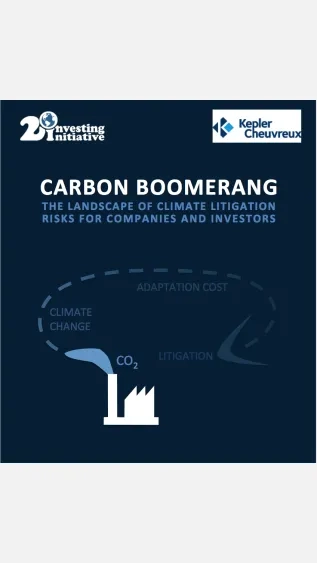
Climate-related litigation risk is the long-term risk that lawsuits targeting companies with high cumulated past emissions create liabilities, based on the company’s share of responsibility in the cost of global warming. It is not limited to direct emissions and likely to occur in countries where extra-territorial jurisdiction and class action lawsuits exist. The tort cost could include adaptation costs at the local level for states and cities (invested by anticipation), thus shortening the time horizon of risk from the years 2050-2100 to today. This concept note focuses on this type of risk.
This report is the first OECD review of South Africa’s environmental performance. It has been carried out as part of the OECD dialogue with South Africa as Key Partner. The report evaluates South Africa's progress towards sustainable development and green growth, with a focus on policies that provide incentives to protect South Africa's exceptionally rich biodiversity and promote more effective and efficient environmental management across different levels of public administration.
The study finds that there is ample scope for enhanced protection of natural resources and growth of agricultural production in Brazil within a Production and Protection framework. From a protection standpoint, the country would benefit from developing mechanisms that significantly drive up the private cost of clearing native vegetation, as well as through the advancement of market-based incentives that promote sustainable practices. From a production standpoint, there is room to increase Brazilian agricultural production via productivity gains, at no apparent cost to environmental conservation.
This paper, Promoting Eco-Innovation: Challenges and potential solutions for private sector development, begins with an exploration, in Chapter 1, of how eco-innovation is addressed in the current international debate. This refers mainly to the climate change negotiations and the recent Rio+20 conference. Chapter 2 then provides a working definition of eco-innovation and examines how it fits with the requirements of private sector development. Chapter 3 contains an overview of the general conditions under which eco-innovations are generated in developing countries, including both the supply side and the demand side. Chapter 4 discusses possible approaches in the context of German development cooperation, and asks which instruments can be used to foster new innovations and encourage their rapid dissemination.
The report includes case studies on the African continent, Egypt, Ethiopia, Germany, and India.