

The notion of green economies seems to have gained momentum in both developed and developing countries. For South Africa, the transition to a green economy presents a mix of challenges and opportunities. This stems from the fact that South Africa faces myriad socio-economic realities that force the country to maintain a generation of industries that contribute directly to the production of greenhouse gases in order to reduce unemployment, poverty and inequality. This paper provides an overview of South Africa’s attempts to migrate to a green economy. It specifically looks at the domestic and continental implications of South Africa’s reorientation of its economy towards a low-carbon growth path. While the country has managed to put together impressive policies meant to steer it onto a trajectory of low carbon economic growth, the realities facing South Africa point to an opposite direction.
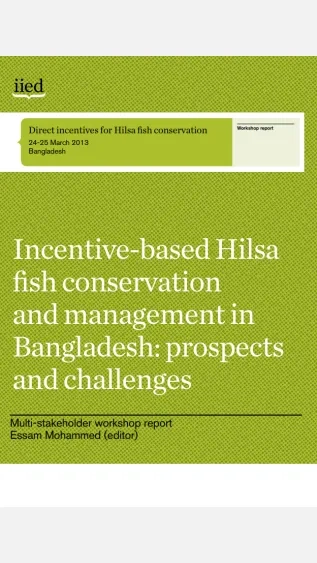
This workshop Incentive-based Hilsa Fish Conservation and Management in Bangladesh: Prospects and Challenges, Multi-stakeholder Workshop was held as part of a project that aims to reduce overfishing of the Hilsa fish in Bangladesh through a payment for ecosystem services (PES) programme.
Fossil fuel subsidies undermine efforts to mitigate climate change and damage the trading system. However, multilateral discussion is hampered by inconsistent definitions and incomplete data. Members do not notify such subsidies as much as they should under the Agreement on Subsidies and Countervailing measures (ASCM), which limits the usefulness of the SCM Committee. The reports of the Trade Policy review mechanism on individual countries and on the trading system draw on a wider range of sources, creating an opportunity for non-governmental organizations (NGOs) to provide the missing data from publicly available sources. This report suggest a new template that could be used for such third-party notifications. The objective is to shine a light on all fossil fuel subsidies that cause market distortions, especially trade distortions. The result should be better, more comparable data for the Secretariat, governments, and researchers, providing the basis for better-informed discussion of the incidence of fossil fuel subsidies and rationale for their use.
The complex inter linkages between trade and climate change governance are increasingly recognised. Examples in point are emissions trading schemes, border carbon measures, and carbon labelling schemes, and various support measures for clean energy—all climate related policies with possible implications for trade and trade law. Against this background, this information note explores the potential for synergy and cooperation between the trade and climate change regimes. This paper will help those working on climate change to better answer questions such as: How can trade measures better address climate change mitigation? Can current climate response measures restrict trade? And how can a strengthened trade and climate governance make them more constructive?
Through this paper, the author builds an equilibrium search and matching model of an economy with an informal sector and rural-urban migration to analyze the effects of budget-neutral green tax policy (raising pollution taxes, while cutting payroll taxes) on the labour market.
The key results of the paper suggest that when general public spending varies endogenously in response to tax reform and higher energy taxes can reduce the income from self-employed work in the informal sector, green tax policy can produce a triple dividend: a cleaner environment, lower unemployment rate and high after-tax income of the private sector. This is due to the ability of the government, by employing public spending as an additional policy instrument, to reduce the overall tax burden when an increase in energy tax rates does not exceed somr threshold level. Thus governments should employ several instruments if they are concerned with labour market implications of green tax policies.
Cities concentrate a large part of the world economy today. Understanding how the urban economy and its decision making function as well as how they are connected to a larger world (regional, national, global) is fundamental to create governance mechanisms and the institutions to move the world towards a green economy. This paper analyses the city through its key economic processes of the transformation of space; circulation (transport); consumption and production and social, knowledge and ecosystem services. Transforming urban processes will only be achieved with better urban governance. As governance is embedded in institutions, it is the foundation for building the legitimate political and social mechanisms to green socio-ecological and economic systems. Yet the question of whether or not current governance systems in these processes are steering cities towards a greener economy, or if they are, how are they affecting people and ecosystems is yet to be addressed.