

In this provocative paper, PCI Executive Director Asher Miller and Transition Movement Founder (and PCI Fellow) Rob Hopkins make a convincing case for why the environmental community must embrace post-growth economics and community resilience in their efforts to address the climate crisis.
This guide aims to encourage early dialogue and diagnosis in and by developing countries on what a green economy would mean for their country. Green economy and green growth are hot topics. Definitions, evidence, debates and increasingly, policies, have tended to be dominated by powerful countries and international groups. Several intergovernmental organisations are making it a priority and are announcing policies and programmes; but they each have different approaches. This proliferating work on the international scene provides rich material which can be highly influential in developing countries. However, there are risks of considerable bias if the concepts are not first explored by stakeholders in-country. As the 2012 Rio+20 United Nations Conference on Sustainable Development concluded, green economies should take very different forms according to a country’s diverse capital endowments and needs. As such, green economic policy and investments need to be tailored at both national and local levels.
This study represents a first attempt within Australia to explore the extent to which a green economy is emerging within different sectors of industry. Its emergence is underway within the energy sector (Newton and Newman, 2013); less so elsewhere. For the built environment sector, given its critical role in sustainable urban development, it is important to understand where the industries that constitute this sector are headed.
The survey on which this report is based probes senior managers in both private and public sector organisations in relation to:
- Perceptions of their current operating environment
- Corporate strategies
- Green business opportunities
- Areas where government can assist business in creating an environment conducive to low carbon green growth.
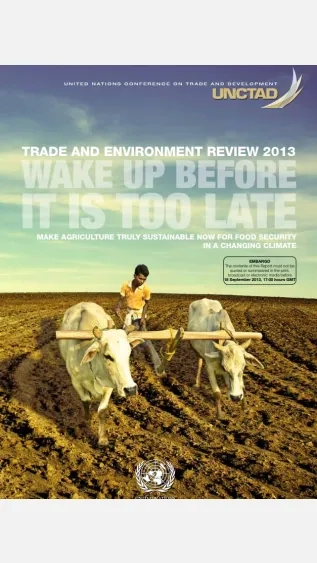
Trade and Environment Review 2013 highlights that the required transformation is much more profound than simply tweaking the existing industrial agricultural system.
Does nature have a price ? How to maximise the monetary value it represents to build another relationship between man and his environment? Can we make the ecological imperative and prosperity of the economy compatible?
This book breaks with the traditional economic thinking, which views nature as a limited stock of resources, for which depletion threatens growth. According to this view based on scarcity, Christian de Perthuis and Pierre-André Jouvet advocate regulatory actions: the services provided by nature, whether they concern climate stability or biodiversity, cannot remain free if one wants to maintain the possibility of growth. Exploring the experimental fields already open on climate and biodiversity, the authors show that there is a pool of innovation and investment for sustainable growth. They bring a new perspective to the issues of energy and environmental transition.