
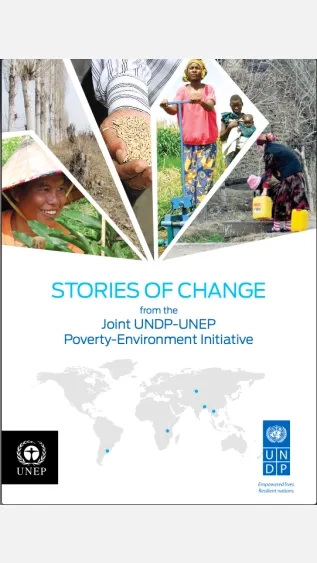
This publication brings together selected Stories of Change to catalyze and motivate governments, stakeholders, and the international development community at large to invest in, and support, poverty-environment mainstreaming across the globe as one element of the transition to an inclusive, green economy.
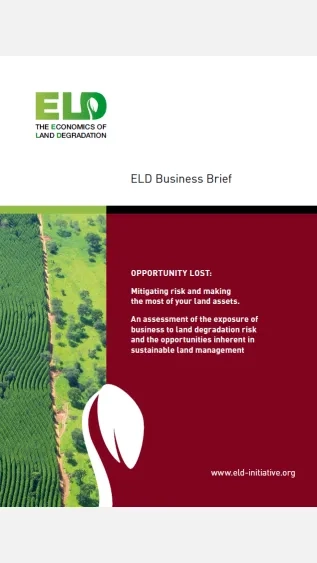
This scoping document Opportunity Lost: Mitigating Risk and Making the Most of Your Land Assets evaluates (on a general level) the risk of land degradation on various industry sectors and discusses the impacts of land degradation on businesses using industry sectors as examples.
Iskandar Malaysia's Actions for a Low Carbon Future is the first of a series that details 10 of the 281 programmes of the Low Carbon Society Blueprint for Iskandar Malaysia. The report shows how actions supported by science can be used to ensure reduction in carbon emission.
This report describes the 9 programmes being implemented with a special feature on Pasir Guadang, a heavy industry area in the south-eastern region of Iskandar Malysia. Each chapter explains what the programme is all about, its relation to the low carbon society, what the intended outcomes are and the stakeholders that are involved. The book is aims to reach out to a wider audience, sharing what Iskandar Regional Development Authority is working towards in collaboration with other agencies.
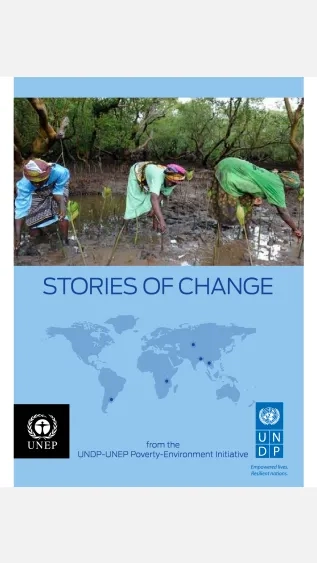
This publication brings together selected Stories of Change which we will hopefully catalyze and motivate governments, stakeholders, and the international development community at large to invest in, and support, poverty-environment mainstreaming across the globe as one element of the transition to an inclusive, green economy. Poverty-environment mainstreaming is a compelling and effective approach and set of tools and capacities for driving the institutional change which can –and ultimately will - deliver sustainable development.
These Stories of Change showcase that innovative and flexible ways of working can be the norm rather than the exception.
The booklet includes the following chapters:
Linking emissions trading schemes is the bottom-up approach to creating a global carbon market. It entails political compromise and a careful assessment of the trade-off between its advantages and disadvantage.
This article points out that the main benefits of linking are the reduction of the aggregate compliance and transactions costs, the reduction of the competitive distortions and the increase of market liquidity. On the other hand, the article identifies also drawbacks in this process: differences in certain design elements can challenge the environmental policy objectives through free-riding and emissions leakage. For all these reasons, a linking project requires solutions to harmonize those design elements which pose barriers to an effective linkage.

This study provides an overview of development trends and environmental performance as well as policy strategies to promote green growth in seven Asian countries - China, India, Indonesia, Philippines, South Korea, Thailand and Vietnam. Despite emerging green growth strategies and green industries in the region, Asian economies are far from becoming green, resource-efficient and sustainable. The emerging discourse on green growth and climate change offers both opportunities as well as new challenges for promoting a broader greening of Asian economies. There are various entry-points and recommendations for policy action, including an appropriate institutional framework and fiscal incentives as well as the support to environmental innovations and decent green job creation.