

Half of the world’s population — 3 billion people — lives below the poverty line, and Asia has the largest share. In pursuit of sustainable economic development and poverty alleviation, there is great potential among low-income households for green consumption, production, innovation, and entrepreneurial activity. This paper shows how an inclusive green growth model can uplift the poor through entrepreneurship and fiscal policy reforms. To make the case, this paper cites examples of institutions and policies in Asia that have successfully generated and tapped into the potentials of low-income households. Low-income households are recognised as resilient, value-conscious consumers and creative entrepreneurs in the inclusive and green growth paradigm. Low-income households can be the engine of a new development strategy; they can be a source of innovation for providing basic services in a green way. Evidence suggests that, without effective financial systems, not all market actors can sustain their businesses.
This is the final report for the joint Adam Smith International and Vivid Economics ‘study of mechanisms to incentivize the financial sector to scale up financing of green investment in Jordan’. The overall aim of the study is to identify the barriers associated with private sector financing of ‘green economy’ activities in Jordan. The study also proposes possible ways to overcome these barriers, drawing, where appropriate, on experiences in other countries. The decision to undertake this study was taken in 2010 by Jordan’s Prime Minister and Ministry of Environment following a Green Financing Seminar held by the Ministry of Environment and the Association of Banks of Jordan. It also follows a Scoping Study – Towards a Green Economy carried out by the United Nations Environment Programme (UNEP) in partnership with the Ministry of Environment carried out in 2011.
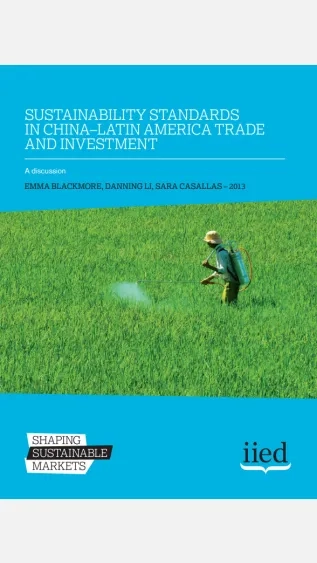
This discussion paper summarises initial evidence on the growing trade and investment between China and Latin America in mining, forestry and agriculture, with a particular focus on Chile, Peru and Brazil.
Using a large plot-level database from Malawi, this paper shows that land tiling alone might not induce greater investment in soil conservation under the exisiting customary inheritance systems and that a reform of the rental market is in order.
The Bank of France organised on 21 March 2013 a conference on the theme of “green growth”. This concept implies finding a balance between the environment and growth in order to maximise welfare – present and future. This involves applying a weighing-up approach for the present and future through an appropriate discount rate. Given this discount rate, it is up to decision makers to develop and to implement policies to combat climate change, in the most effective way possible.
To achieve this, it is necessary to develop assessment tools for climate policies. In addition, greater global coordination seems necessary today. Although the main responsibility for the increase in greenhouse gas emissions (GHG ) lies currently with developed countries, if emerging and developing countries follow the same pattern of growth, this could significantly worsen the situation; thus a global agreement is paramount.
On a smaller scale, and in the absence of a binding global agreement for the moment, it is up to everyone to try to be more respectful of the environment and businesses have a role to play in addressing the challenge of sustainable development.
The ocean is an essential part of the world economy for transport and for the resources it contains and activities it supports. Yet, the health of oceans is in decline and future opportunities are being lost through this degradation. The current system of governance and management of oceans is in need of urgent reform. This discussion paper provides a concrete framework for considering how this might be achieved.
The paper sets out a 5-part practical action framework to transform the way in which oceans are governed to create a more harmonised approach that supports long-term environment, social and economic goals.