

Using novel data on patents, trade of equipment goods, and foreign direct investments and insights from the economic literature, the paper seeks to lay out the state of knowledge on the role of innovation and the diffusion of technologies in the greening of global value chains as well as some of the main policy issues. A special emphasis is put on developing countries -- distinguishing emerging economies and least-developed countries -- and on climate-mitigation technologies. Emerging economies are already reasonably well integrated in the global economy. As a consequence, technologies flow in through the imports of capital goods and local investments by multinational enterprises owning technologies. Pushing further technology transfer requires strengthening intellectual property rights, lowering barriers to trade and investments and improving technological absorptive capacities. In contrast, their role in innovation is limited. Standard tools of innovation policy - public research and development, public support to private research and development, better access to finance - should develop.
Ho Chi Minh City faces significant and growing flood risk. Recent risk reduction efforts may be insufficient as climate and socio-economic conditions diverge from projections made when those efforts were initially planned. This study demonstrates how robust decision making can help Ho Chi Minh City develop integrated flood risk management strategies in the face of such deep uncertainty. Robust decision making is an iterative, quantitative, decision support methodology designed to help policy makers identify strategies that are robust, that is, satisfying decision makers’ objectives in many plausible futures, rather than being optimal in any single estimate of the future. This project used robust decision making to analyse flood risk management in Ho Chi Minh City’s Nhieu Loc-Thi Nghe canal catchment area. It found that the soon-to-be-completed infrastructure may reduce risk in best estimates of future conditions, but it may not keep risk low in many other plausible futures. Thus, the infrastructure may not be sufficiently robust.
This scoping study provides ideas, techniques and case studies on how renewable energy can be better communicated to and by policy makers, decision makers and other stakeholders. It examines 15 case studies of renewable energy communications strategies from government, the private sector, and civil society. The majority of cases were found to lack rigorous, well-planned and adequately evaluated communications strategies. The study looks at how more targeted, effective renewable energy communications campaigns can be achieved through the use of more consistent, holistic and rigorous approaches to pre- and post-campaign development.
Studying the roles of governments in adopting green innovations is significant for analysing the transition to a more sustainable energy system. This article presents a comparative study of policies for popularizing domestic solar water heaters in three countries: China, Israel and Australia. Expanding the analysis beyond the economics of innovation, it demonstrates the institutional dimension of green technology deployment in these three countries. By examining the diverging roles of governments in facilitating green technology adoption in existing social routines and practices, it finds that governments' motivations, support and implementation mechanisms are remarkably different in these three countries. In particular, the paper argues that solar water heater popularization has been distinguished as a business opportunity in China, energy security in Israel and environmental responsibility in Australia. In addition, the institutional settings have a real impact on governments' roles in adopting green innovations, in terms of the policy instruments chosen and implementation mechanisms.
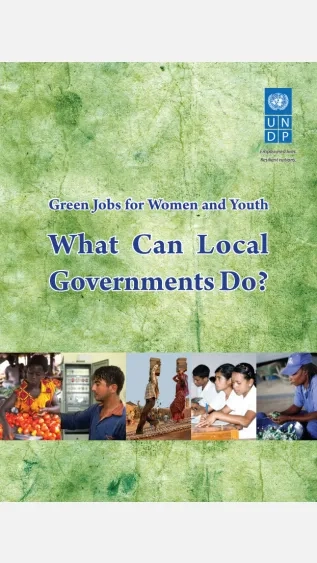
This paper presents examples of policies and programmes initiated by local governments that promote green jobs especially for women and youth. The aim is to inspire more local governments to consider policies that address the economic, social and environmental dimensions of sustainable development. The report includes case studies from South Africa, the Phillippines, Senegal, Bolivia, Argentina, Colombia, Bangladesh, Zimbabwe, Lesotho, Burundi and Viet Nam.
This report maps existing and emerging carbon pricing initiatives around the world. It does not provide a quantitative, transaction-based analysis of the international carbon market since current market conditions invalidate any attempt to undertake such an analysis. The development of national and subnational carbon pricing initiatives in an increasing number of countries calls for a different focus. The uncertainty surrounding the existing carbon markets in the last years has prevented valuable resources to be channeled to low-carbon investments, particularly from the private sector. Following the economic downturn and slow economic recovery in major economies, industrial output plummeted and the demand for carbon assets used for compliance fell. With limited support, prices reached historical lows. At the same time, several national and sub-national carbon pricing initiatives are emerging. It is not surprising that several of these new carbon pricing initiatives also include design features to prevent similar developments in the future, including mechanisms to stabilize the carbon price.