
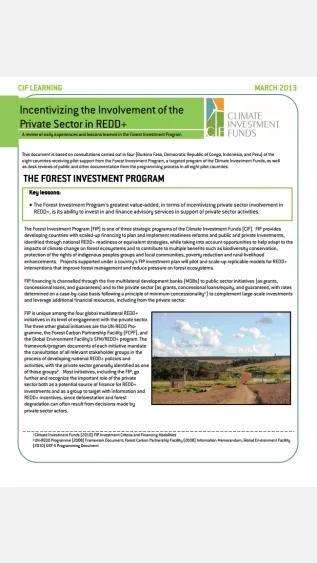
The Forest Investment Program (FIP) is one of three strategic programs of the Climate Investment Funds (CIF). FIP provides developing countries with scaled-up financing to plan and implement readiness reforms and public and private investments, identified through national REDD+ readiness or equivalent strategies, while taking into account opportunities to help adapt to the impacts of climate change on forest ecosystems and to contribute to multiple benefits such as biodiversity conservation, protection of the rights of indigenous peoples groups and local communities, poverty reduction and rural livelihood enhancements.
The OECD Environmental Performance Review Programme provides independent assessments of countries’ progress in achieving their domestic and international environmental policy commitments, together with policy relevant recommendations. They are conducted to promote peer learning, to enhance countries’ accountability to each other and to the public, and to improve governments’ environmental performance, individually and collectively. The Reviews are supported by a broad range of economic and environmental data. Each cycle of the Environmental Performance Reviews covers all OECD member countries and selected partner countries.
This report is the third OECD review of Italy’s environmental performance. It evaluates progress towards sustainable development and green growth, with a focus on policies that promote more effective and efficient water management and provide better incentives to tackle climate change.

Institutional investors, which together manage assets of over $70 trillion, often have investment objectives that are aligned with the investment profile of low-carbon infrastructure. At first glance, access to this large pool of capital and the alignment of objectives should help lower the costs of financing renewable energy. In this study, CPI finds that while these investors could supply a significant share of the total required investment, various factors limit the extent to which they can invest in a way that could lower the cost of financing renewable energy. Furthermore, financial regulation of institutional investors, regulation of energy markets, and renewable energy policy, often create additional obstacles to renewable energy investment.
This publication Myths and Facts about Bioenergy in Africa presents facts about bioenergy in sub-Saharan Africa while addressing false assumptions that are often claimed against this sector.
A decent environmental quality is a necessary condition for survival of humankind in general and human development in particular. Environmental pollution is a great challenge in developing countries, where especially the poorest are most likely to suffer. Reflecting the state and the dynamics of the environment is essential for science and policy advice. Environmental indicators capture the physical, biological or chemical characteristics of the environment. Environmental composite indicators merge several environmental indicators in order to summarise the multifaceted state of the environment at national level into one single score. These composite indicators allow for cross-country comparisons. The analysis here includes four cross-country composite indicators: the Environmental Vulnerability Index, the Environmental Performance Index, its predecessor the Environmental Sustainability Index and the Ecosystem Wellbeing Index. In addition, the dimension Environmental Wellbeing of the Sustainable Society Index and the Living Planet Index are analysed. Currently, the latter has mainly been constructed at a global scale with only limited availability at national level.
By the end of 2015, the United Nations will adopt a new global development agenda as a follow-up to the Millennium Development Goals (MDGs). To this end, UN member states are now engaged in a debate on defining universal Sustainable Development Goals (SDGs), as decided by the 2012 Rio+20 Summit. According to the final declaration of that summit, these goals should “address and incorporate in a balanced way all three dimensions of sustainable development and their interlinkages” and should “be coherent with and integrated into the United Nations development agenda beyond 2015” (§ 246).