

This paper outlines a conceptual and policy approach to bringing social concerns to the forefront of green economy and sustainable development debates. It examines a wide range of social problems and other issues associated with green economy, reasserting that any development transformation must be both green and fair; leading to a green society not just a green economy. However, different transition pathways exist, each with different developmental implications. This paper addresses the key role of social policy, agency and participation in crafting transition paths that are green and fair. A comprehensive or transformative social policy is argued to play a key role in mitigating unfair consequences, influencing behaviour and transforming patterns of inequality. This paper concludes by highlighting issues of fragmentation associated with knowledge, institutional arrangements and socil agency, and suggests the need for 'joined-up analysis, policy and action'.
This summary was prepared by Eldis.
This paper Does Eco-Certification have Environmental Benefits?found that organic certification improves coffee growers' environmental performance.
The restitution of parkland to the Khomani San “bushmen” and Mier “agricultural” communities in May 2002 marked a significant shift in conservation in the Kgalagadi Transfrontier Park and environs in South Africa. Biodiversity conservation will benefit from this land restitution only if the Khomani San, who interact with nature more than do other groups, are good environmental stewards. To assess their attitude toward biodiversity conservation, this study used the contingent valuation method to investigate the economic values the communities assign to biodiversity conservation under three land tenure arrangements in the Kgalagadi area. For each community and land tenure arrangement, there are winners and losers, but the winners benefit by more than the cost that losers suffer. The net worth for biodiversity conservation under the various land tenure regimes ranged from R928 to R3456 to R4160 for municipal land, parkland, and communal land respectively for the Khomani San, compared to R25 600 to R57 600 to R64 000 for municipal land, parkland, and communal land respectively for the Mier.
The concept of green economy has received significant international attention over the past few years both as a tool to address the 2008 financial crisis as well as one of the two themes for the 2012 United Nations Conference on Sustainable Development (Rio+20). This has resulted in a rapidly expanding literature and emerging international practice as well as new partnerships, coalitions and platforms.
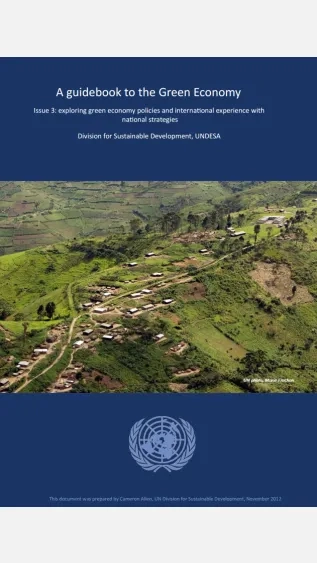
Green economy in the context of sustainable development and poverty eradication was one of two themes at the UN Conference on Sustainable Development held in Rio de Janeiro in June 2012 (or Rio+20).
Negotiations on green economy in the lead up to Rio+20 were challenging and the concept became a source of controversy and disagreement. Despite these challenges, governments agreed at Rio+20 to frame the green economy as an important tool for sustainable development; one that is inclusive and can drive economic growth, employment, and poverty eradication, whilst maintaining the healthy functioning of the Earth’s ecosystems. Importantly, the outcome document also recognises that capacity building, information exchange and experience sharing will be critical for implementing green economy policies. In this context, the document invites the UN to work with partners to provide support to developing countries and to develop toolboxes, best practices, methodologies and models to aid green economy policy design and implementation.