

The government as an entity is quite often the largest, single consumer of goods and services in developed as well as developing countries. Government procurement can be a powerful tool for positive environmental change by creating a market for environmental goods and services. At the same time, procurement policies will need to be designed and implemented in a manner that does not discriminate against trading partners. What sort of space is available in the context of existing trade-rules for governments to pursue proactive procurement policies for sustainable energy goods and services? Is there a need to review existing rules so as to enhance their effectiveness with regards to the objectives of strengthening markets for renewable energy? This paper, by Alan Herve and David Luff, sheds light on these questions and also explains how a possible Sustainable Energy Trade Agreement could spur reform while ensuring a level playing field in procurement markets for producers of sustainable energy goods and services worldwide.
This paper focuses on how developing countries can change the way they prepare for disasters so they are better equipped to sustain economic growth. It discusses the importance of considering the goals of key decision makers and the need to understand the perceptions, systematics biases, and heuristics used by the relevant interested parties (the affected public, private and public sector organizations, and nongovernmental organizations) in choosing between alternatives. The paper highlights the importance of undertaking benefit-cost analysis to evaluate disaster risk reduction measures, recognizing that decision makers might not make meaningful use of this policy tool given their behavioral biases and simplified heuristics. To address these issues, the authors propose green growth strategies that involve multi-year contracts coupled with short-term incentives that have a chance of being implemented. The strategies focus on the role of multi-year micro-insurance, long-term loans, and multi-year catastrophe bonds that reflect the institutional arrangements in the developing country.
ICTSD senior fellow and Professor Emeritus Thomas Brewer, addresses the issues associated with technology transfer used by firms, namely international direct investments, licensing, and trade in services and goods. The author makes a case for the creation of a new international institutional architecture built around a sustainable energy trade agreement (SETA), with a view to enhancing such transfer. The paper considers a wide range of related topics that need to be addressed in designing and negotiating a SETA, especially four key elements: subsidies, government procurement, standards and intellectual property rights.
This report defines the scope of the environmental sector and provides a detailed methodology based on which data has been collected, analyzed, and reported. Also, it gives a comprehensive analysis of the preliminary findings of both quantitative and qualitative data, including macroeconomic performance, policy and legal frameworks, methodology, and preliminary assessment of the Public Environmental Expenditure Review (PEER).
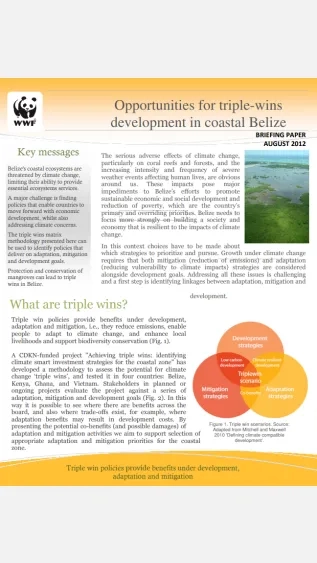
The serious adverse effects of climate change, particularly on coral reefs and forests, and the increasing intensity and frequency of severe weather events affecting human lives, are obvious around us. These impacts pose major impediments to Belize’s efforts to promote sustainable economic and social development and reduction of poverty, which are the country’s primary and overriding priorities. This briefing paper, Opportunities for triple-wins development in coastal Belize, examines key actions underway to promote at Mangrove conservation and restoration along the Placencia Lagoon, Belize.
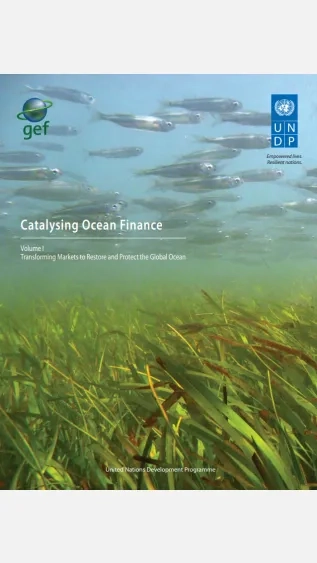
Catalysing Ocean Finance demonstrates how a modest investment of public finance—on the order of $5 billion over the next 10-20 years—can scale up proven ocean planning and policy tools, leverage financial flows, transform ocean markets, and reverse the global decline in ocean health.