
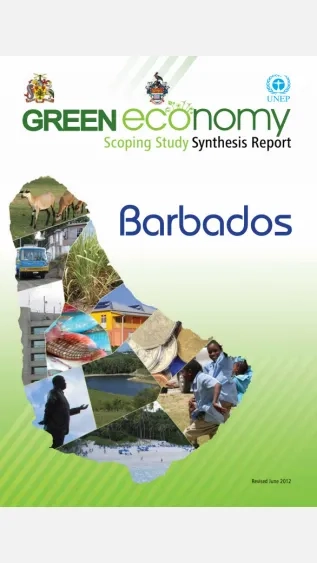
This synthesis report focused on five key sectors (agriculture, fisheries, building, transportation and tourism) in Barbados to scope the transition to a green economy on the island. In particular, the study focuses on the applicability of the accepted UNEP definition of green economy to Small Islands Developing States, of which Barbados is one.
Barbados is vulnerable to both fluctuations in the price of its imported fossil fuels and at risk from the destruction of its marine and coastal ecosystems from climate change therefore the report states that the pursuit of a greener path to economic development is highly attractive to the country.

This report summarizes the results of a recent review of the emerging experience with the design and implementation of policy instruments to promote the development of renewable energy (RE) in a sample of six representative developing countries and transition economies ('developing countries') (World Bank 2010). The review focused mainly on price- and quantity-setting policies, but it also covered fiscal and financial incentives, as well as relevant market facilitation measures. The lessons learned were taken from the rapidly growing literature and reports that analyze and discuss RE policy instruments in the context of different types of power market structures. The analysis considered all types of grid-connected RE options except large hydropower: wind (on-shore and off-shore), solar (photovoltaic and concentrated solar power), small hydropower (SHP) (with capacities below 30 megawatts), biomass, bioelectricity (cogeneration), landfill gas, and geothermal. The six countries selected for the review included Brazil, India, Indonesia, Nicaragua, Sri Lanka, and Turkey.
This publication aims to develop a set of green economy principles based on some of the most prominent existing principles relating to sustainable development and the green economy from the existing literature. Fifteen principles are identified that represent a consolidation of existing international agreements and more radical and forward‐thinking proposals, cutting across The Stockholm Declaration, the Rio Declaration, The Johannesburg Declaration, The Earth Charter, The One Planet Living Principles, The Green Economy Coalition, the TUC ‘Just Transition’ principles, and The New Economics Foundation.
This report from UNESCO recognises that there are increasing social disparities and inequity in the world, alongside population growth, climate change, the deterioration and pollution of the environment, the unsustainable use of freshwater and depletion of ocean resources, as well as increasing cases of natural and human‐made disasters. The report reveals UNESCO’s vision that aims to counter the above challenges by providing a ‘new way forward’ through the development of an inclusive green society and economy. The report identifies five priority areas for UNESCO in the transition to a green economy. These are:
The paper indicates that policies promoting greener and sustainable agriculture offer multiple economic, social and environmental benefits, including a number of trade opportunities. However, there are some challenges, such as the increasing demand for food, and the increasing global water stress, which will require the adoption of practices that enhance water-use efficiencies.