

Search

Search Results
Default Image

The impact of trade on a green economy transition depends in large part on how trade policies are designed and applied. This policy brief shows that trade can be an overall driver in the transition to a green economy by helping to create and strengthen markets for sustainably produced goods and services.
 
However, the author shows that this requires fostering the exchange of environmentally friendly goods and services, and increasing resource efficiency. Otherwise, if managed poorly, unrestrained trade can contribute to environmental degradation, unsustainable resource use and increased wealth disparities.
 
The paper finds that the existence of national and institutional conditions to cope with the impact of liberalisation is of great importance.

Default Image

Trade liberalisation can provide access to green goods and technologies at lower cost and greater efficiency. This paper illustrates that liberalising trade in environmental goods can create new markets and export opportunities, thus supporting export-led development strategies.
 
The document figures that increased deployment of cheaper and better-quality environmental goods helps countries counter environmental degradation and climate change, facilitating the transition to a green economy. In this respect, the author notes that the greatest growth potential for environmental goods (EGs) is to be found in developing countries. Nevertheless, non-tariff barriers (usually technical regulations) hamper developing countries ability to trade in environmental goods.
 
The paper underlines that negotiations on environmental goods and services are part of the WTO Doha Round.

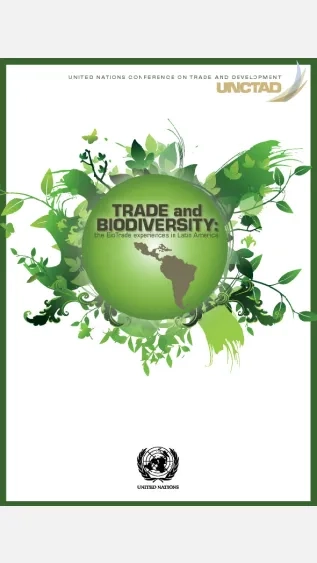
This paper illustrates the potential for developing sustainable environment management practices such as BioTrade in Latin America.

Default Image

Changing Pace is an analysis of policy initiatives aimed at accelerating progress towards inclusive and sustainable growth. It complements the WBCSD report Vision 2050, The new Agenda for Business, published in 2010.

Default Image

The outcome document for the United Nations Conference on Sustainable Development 2012 includes a chapter on green economy in the context of sustainable development and poverty eradication. Whilst not a strong chapter, it is significant as it is the first reference to green economy in the outcome document of a major UN summit. The chapter helps to frame the green economy concepts, identifying a range of principles for applying the concept in a way that achieves sustainable development and contributes to poverty eradication. Importantly, the document invites the UN system, in cooperation with relevant donors and international organisations, to coordinate a number of green economy deliverables relating to tools, best practices, methodologies and platforms that can assist with green economy capacity building.

This summary was prepared by the Division for Sustainable Development, UNDESA.

Default Image

Fossil fuels remain a vast energy resource, are widely distributed around the world, and remain heavily relied upon for energy generation. Reducing local pollution and emissions of greenhouse gases (GHGs) from the combustion and processing of these fossil fuels is set to be one of the world’s biggest challenges in the years ahead. Carbon capture and storage (CCS) could have significant impact as a carbon mitigation technology in GHG emitting industries. This report assesses some of the most important barriers facing CCS deployment in developing and transition economies in the Balkans and Southern African regions.
 
This report assesses the economic and environmental GHG impacts of potential CCS deployment in the power sector in the two regions using a techno-economic model. It analyses legal and regulatory frameworks that could be applicable to potential CCS deployment in these regions and assesses the role of climate finance to support prospective investment needs for CCS projects in developing countries.