

The cities of the 21st century are the largest sites of human settlement today and are increasingly acting as critical nexus points of social, economic, ecological and technological change. This is especially evident in the developing world city context, where growth is most rapid and where future sustainability challenges will be most severe - all this in the light of growing inequalities, poverty and the pervasiveness of slums and informality. This publication presents a rationale for socially inclusive urban transitions to sustainable growth and draws on a range of case studies and theoretical and analytical considerations to establish the basis of the argument. It outlines practical steps that cities can take towards resource efficiency, including: the integration social measures into urban development; governance approaches that engage local communities and civil society groups; financial incentives and subsidies for green technologies; technology transfer; and innovation. The summary was prepared by Eldis.
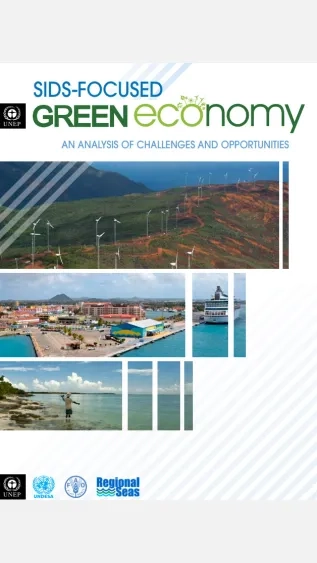
The report SIDS-focused Green Economy seeks to show how a transition to a green economy can contribute to advancing sustainable development in SIDS.
This report is part of 'China 2030'. China should complete its transition to a market economy through enterprise, land, labor, and financial sector reforms, strengthen its private sector, open its markets to greater competition and innovation, and ensure equality of opportunity to help achieve its goal of a new structure for economic growth. These are some of the key findings of China 2030, a joint research report by a team from the World Bank and the Development Research Center of China's State Council.
Early in 2012 Mexico, as G20 President, invited international organisations to examine practical actions that could be undertaken to sustainably improve agricultural productivity growth, in particular on small family farms. The preparation of this report, co-ordinated by the FAO and the OECD, is a collaborative undertaking by Bioversity, CGIAR Consortium, FAO, IFAD, IFPRI, IICA, OECD, UNCTAD, Coordination team of UN High Level Task Force on the Food Security Crisis, WFP, World Bank, and WTO. The recommendations provided are broadly of two types: specific actions that can contribute in some way to improving productivity growth or sustainable resource use (whether building on existing initiatives or suggesting new activities) and more general proposals that may not be actionable as presented but that serve to highlight areas for priority attention.
This report examines how green growth and sustainable development policies can be incorporated into structural reform agendas. Indeed, as demonstrated in the report, many of these policies are closely linked and synergistic with the framework policies applied by G20 governments in their efforts to pursue strong and sustainable growth.
The primary objective of this study is to design an integrated strategy, based on government criteria and expert assessment, for the transformation of the economy of Carriacou and Petite Martinique into a greener and more sustainable economy. The study seeks to design an approach for a transition to sustainable development for Carriacou and Petite Martinique according to criteria specified by government representatives and national experts. The experiences and lessons learned from this study will provide valuable information and awareness for other Small Island Developing States (SIDS). The study will generate substantive knowledge about the most important development blocks necessary for sustainable economies of SIDS with similar challenges and objectives.