

This toolkit focuses on inclusive green growth—growth that not only helps green economies, but also helps move towards sustainable development by ensuring environmental sustainability contributes to, or at least does not come at the expense of, social progress. While there is good reason to think that improved environmental performance will benefit the poorest and most vulnerable, green growth policies must be carefully designed to maximise benefits and minimise costs for them, particularly during the transition. There is thus a critical need for policy design that also ensures that skills are upgraded and that jobs are decent, that vulnerable groups are not marginalised or left behind, and that revenues from fiscal reforms are also channeled into broader social protection and health measures.
A number of the tools that will be mobilised to implement inclusive green growth policies are "classic" public management tools, but this document focuses only on the most relevant instruments vis-à-vis green growth in developing countries, as these instruments are widely known and implemented the world over. What this toolkit aims for instead is to provide policy-makers with:
This report Inclusive Green Growth in Latin America and the Caribbean argues that the region faces an uphill battle to sustain such growth rate over time without fully embracing "green" and "inclusive" policies across the board.
This report TEEB in Business and Enterprise is for a wide array of enterprises, including those with direct impacts on ecosystems and biodiversity, such as mining, oil and gas and infrastructure; for those businesses that depend on healthy ecosystems and biodiversity for production, such as agriculture and fisheries; for industry sectors that finance and undergird economic activity and growth, like banks and asset managers, as well as insurance and business services; and for businesses that are selling ecosystem services or biodiversity-related products such as eco-tourism, eco-agriculture and bio-carbon.
In 2005, the concept of green growth was introduced in the Asia-Pacific region as a strategy for sustainable growth in developing countries. This roadmap, produced by the United Nations Economic and Social Commission for Asia and the Pacific (UNESCAP), is intended for the use of member states to help policymakers find win-win strategies for promoting growth and reducing carbon emissions. Drawing upon innovative approaches, particularly from the Republic of Korea, this manual lays out the challenges, strategies and policy options of green growth in several critical sectors.
The document is divided into two parts, with additional case studies and fact sheets available via CD-ROM. Part one presents an overview of the opportunities and challenges the region faces regarding low carbon green growth. It also discusses the system change required to shift focus to this new development path. Part two of the roadmap shows how to start the process of pursuing green growth through five different tracks, outlined below, which are seen as core elements of necessary systemic change:
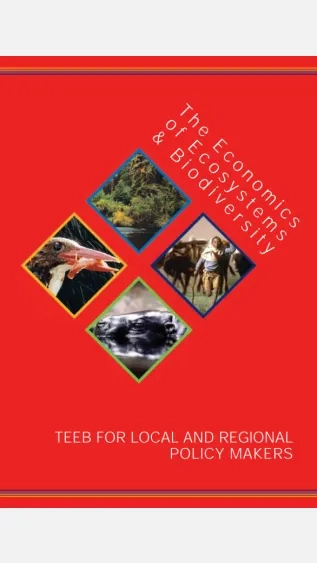
This document is intended to offer inspiration and practicable suggestions for the improvement and maintenance of the welfare of the environment and its inhabitants. TEEB in Local and Regional Policy and Management shows how by taking nature’s benefits into account, decision makers can promote local development to ensure human well-being and economic growth and stability, while also maintaining environmental sustainability.
This volume of the TEEB series of studies explores the potential for local development provided by an approach based on nature. It offers examples of successful implementation of this approach from across the world, highlighting the importance of local decision making in management and planning. The study provide tools and practical guidance for reform, and examines what local governments can do with respect to natural resource use and management, maintaining and supporting biodiversity, local and regional urban and spatial design, as well as market-based approaches, such as Payment for Ecosystem Services (PES).
This joint study by the International Labour Organisation (ILO) and the United Nations Environment Programme (UNEP) highlights that the transformation to a greener economy could generate 15 to 60 million additional jobs globally over the next two decades and lift tens of millions of workers out of poverty. The report documents evidence that for countries at all levels of development the drive towards environmental sustainability and greener economies is gaining momentum. The study indicates that job growth has been particularly strong in the renewable energy sector, with a global increase of 21 per cent per annum. As a result, the sector now employs close to 5 million workers; more than double the number employed only a few years ago.
This summary was prepared by Eldis.