

More than 90% of impacts of climate change are related to water issues. These impacts are not only on water supply for household, industries and agriculture, but also on disasters and hazards during heavy rainfall, with flooded areas and landslides. During droughts, forest fires and haze have become the norm. The spread of poor quality water during floods and concentration of toxic water during drier months are an added health hazards. as such water security has become a truly global challenge.
This report describes an evolving policy landscape in Asia and the Pacific characterised by a changing economic reality, rising demand for resources, increasingly apparent impacts of climate change and increased risk and uncertainty. It provides insights into Asian and Pacific resource use trends and outlines key actions that governments can pursue to help bring economic growth strategies in closer alignment with the objective of sustainable development. It also provides examples of strategies for improving resilience to help deal with the increasing levels of risk faced by societies and economies. The report is the product of a combined effort by three institutions: the Asian Development Bank (ADB), the United Nations Economic and Social Commission for Asia and the Pacific (ESCAP) and the United Nations Environment Programme (UNEP).
This summary was prepared by Eldis.
Released to mark the African launch of the 2012 UN International Year of Sustainable Energy for All, this report is based on a survey of 38 mostly private sector institutions involved in energy infrastructure finance in developing countries. It outlines the current obstacles to sustainable energy solutions in Africa, including the cost of electricity and difficult grid access. It highlights the need for an estimated 7,000 megawatts (MW) of new generation capacity annually to meet the continent’s growing energy demands, and argues that Africa has a wealth of untapped domestic resources. The report underscores the opportunities to improve energy security and to establish regional energy markets.
This summary was prepared by Eldis.
This paper discusses the extent to which the predicted growth of aviation in a carbon-constrained world is possible given the known operational and technological options, and in particular the extent to which aviation biofuels form part of the answer. Even without a carbon constraint, aviation faces significant challenges. If capping global greenhouse gas emissions remains a serious goal, then aviation‘s problems intensify. With these challenges in mind, some fundamental questions are raised, for instance:
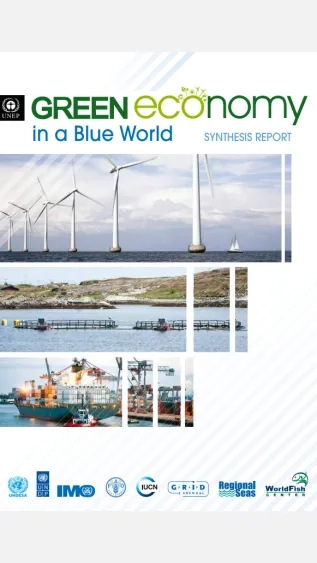
This report Green Economy in a Blue World: Synthesis Report analyses how key sectors that are interlinked with the marine and coastal environment – the blue world – can make the transition towards a green economy.
The Life Beyond Growth publication by AtKisson for the Institute for Studies in Happiness, Economy and Society, explores, as a basis, alternatives and complements to GDP-measured growth as a framing concept for social progress. The report begins by analysing the history of the economic growth paradigm, summarising the key factors that have supported the dominance of growth in global history, and then continues to provide insight on some of the contemporary political factors and technical initiatives that have led to new thinking on green growth and human well-being as indicators for social progress.
The document aims to provide a summation of the current state of the art in relation to rethinking economic growth in favour of alternative models such as green growth. It concludes with a section on the ethics of growth and happiness and a vision for the future.
This summary was prepared by UNDESA.