

This paper explores in more detail the sustainability and economic challenges and opportunities of industrial development. In keeping with UNIDO’s mandate, the focus is on industry in the developing countries. How can enterprises in these countries become greener and lessen their environmental footprint while at the same time continuing to grow and deliver goods, services and jobs to their populations? What role should the governments of developing countries play in this process? Answers to these questions must take into account one overriding imperative: that industry in developing countries needs to grow. Industrial development is the only mechanism that will enable developing countries to reduce the level of poverty and hardship they face. The conclusion offers a strategy for the development aid community, designed to help developing countries bridge the gap between the present and the future.
Technology development and its rapid diffusion are considered crucial for tackling the climate change challenge. In particular, enhancing technology transfer towards developing countries has been an integral part of the global climate change regime since the inception of the United Nations Framework Convention on Climate Change (UNFCCC). The Bali Action Plan reaffirmed its centrality, and the Copenhagen Accord calls among other things for the establishment of a mechanism to accelerate technology development and transfer.
The role of intellectual property rights (IPRs) in the transfer of climate change technologies has emerged as a particularly contentious issue in the past two years. Against this background, the United Nations Environment Programme (UNEP), the European Patent Office (EPO) and the International Centre for Trade and Sustainable Development (ICTSD) joined forces to undertake an empirical study on the role of patents in the transfer of clean energy technologies (CETs).
NREGA has been devised as a public work programme and is focussed around a rights-based approach to development. Key focus is on providing income security to rural households through guaranteed wage employment; reduce/check distress migration from the rural to urban areas and create durable community assets (in the rural areas) to trigger an overall development of around six lakh Indian villages.
This report evaluates the requirements for an assessment of climate change impacts on agriculture to guide policy makers on investment priorities and phasing. Because agriculture is vital for national food security and is a strong contributor to Brazil's GDP growth, there is growing concern that Brazilian agriculture is increasingly vulnerable to climate variability and change. To meet national development, food security, climate adaptation and mitigation, and trade goals over the next several decades, Brazil will need to significantly increase per area productivity of food and pasture systems while simultaneously reducing deforestation, rehabilitating millions of hectares of degraded land, and adapting to climate change. There is inadequate data to accurately model projected climate challenges facing Brazil. The report concludes that key integrated and linked interventions are needed in the short term to significantly improve currently available assessments of climate change impact on Brazilian agriculture and to guide policy makers with the priorities and phasing of needed investments.
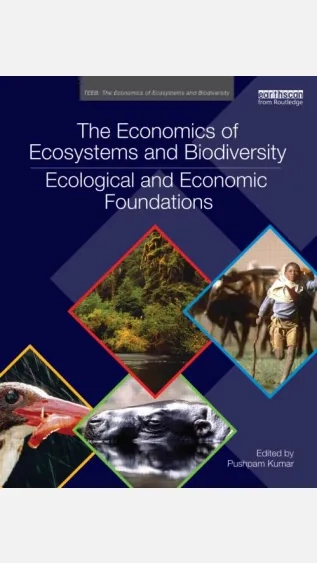
The goal of The Economics of Ecosystems and Biodiversity (TEEB) Ecological and Economic Foundations is to provide the conceptual foundation to link economics and ecology, to highlight the relationship between biodiversity and ecosystem services and to show their importance for human well-being. This volume of the overal TEEB series tackles the challenges of valuing ecosystem services, as well as issues related to economic discounting. It aims to quantify the costs of inaction and examine the macroeconomic dimension of ecosystem services loss. This information will focus on improving our understanding of the economic costs of biodiversity loss and ecosystem degradation.
Examples include water and air quality regulation, nutrient cycling and decomposition, plant pollination and flood control, all of which are dependent on biodiversity. They are predominantly public goods with limited or no markets and do not command any price in the conventional economic system, so their loss is often not detected and continues unaddressed and unabated. This in turn not only impacts human well-being, but also seriously undermines the sustainability of the economic system.