
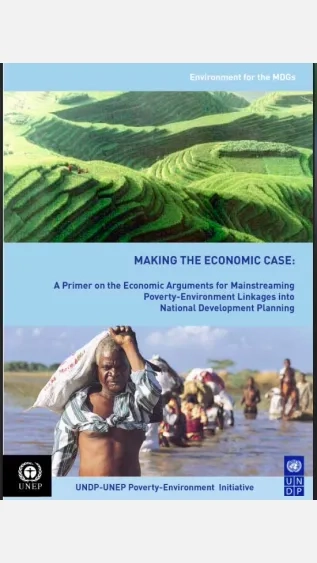
This primer provides guidance on presenting evidence about the economic, development, and poverty reduction benefits of the environment to public sector decision-makers, so as to justify and promote “environmental investment”.

We see the expression “sustainable development” everywhere these days, but what does it mean? Can we really pursue sustainable economic growth without harming our societies and the environment? And if we pursue prosperity today, are we condemning our children and grandchildren to poverty tomorrow?
The OECD works on many issues related to sustainable development – climate change, growth in developing countries, corporate social responsibility and much more. Using straightforward language and real-world examples, OECD Insights: Sustainable Development draws on that expertise to explore these vital issues.
OECD Insights: Sustainable Development provides an essential introduction to the complex relationships between the economy, society and the environment. As global inequality and climate change become mainstream concerns, it asks the questions our generation needs to ask in terms everyone can understand.
Cette rapport final reprend les conclusions principales du rapport du même nom. Elle présente les principaux résultats, soulignant nettement que la préservation et la bonne gestion des ressources naturelles est un facteur important de la croissance économique et de la lutte contre la pauvreté.
Cette note de synthèse reprend les conclusions principales du rapport du même nom. Elle présente les principaux résultats, soulignant nettement que la préservation et la bonne gestion des ressources naturelles est un facteur important de la croissance économique et de la lutte contre la pauvreté.
The Second Environmental Performance Review of Kazakhstan takes stock of the progress made by Kazakhstan in the management of its environment since the country was first reviewed in 2000.
This report reviews the current status of payments for watershed services (PWS) in developing countries. It highlights the main trends in the evolution of these schemes, by identifying and analyzing case profiles, constraints and information gaps in Section 2, followed by a brief overview of general trends and setbacks at the international, national and local levels. Section 4 outlines the key characteristics of PWS, namely related to supply and demand and payment mechanisms. And, Sections 5 and 6 synthesize the available evidence on the environmental and social impacts of PWS, and draw lessons for the design of future initiatives.
Free online case study resources can be downloaded from the website that accompanies this study at: www.watershedmarkets.org