

This report provides a preliminary review of ecosystem services in Mozambique and the corresponding constituents and determinants of well-being related to the availability of these services. This paper is one of seven scoping studies prepared by the International Institute for Sustainable Development for the United Nations Environment Programme.

This report provides an overview of PFMs that mobilise and leverage commercial financing, build commercially sustainable markets, and increase capacity to deliver clean energy and other climate-mitigation technologies, projects and businesses. These mechanisms can play a prominent role in the implementation of an international mitigation strategy.
The report is based on a substantial body of experience in a wide variety of developed and developing countries. It suggests ways in which PFMs could be used at the national and international scale, offers scale up and replication strategies, and identifies how they might fit into a new financial framework under the UNFCCC.
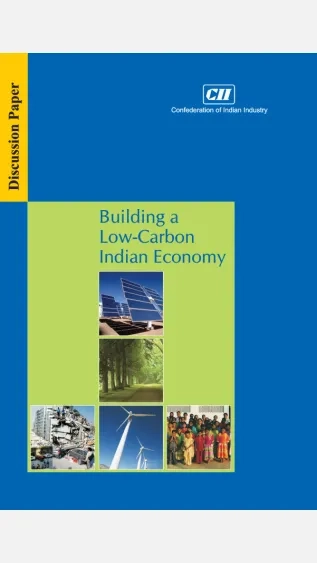
The ‘Building a Low‐Carbon Indian Economy’ report, by the Confederation of Indian Industry, recognises that although India is undergoing a phase of rapid industrial development there are clear signs that ‘industry in India has adopted an approach that can help India leapfrog to a low‐carbon economy’. The report asserts that this can be done by adopting suitable policies to promote non‐carbon intensive fuels, renewables and state‐of‐the‐art technologies to promote energy efficiency.
The strategy identifies 12 priority areas with the potential to mitigate India’s carbon emissions and put the country on the path to a low‐carbon economy. These are: Renewable Energy, Energy Efficiency, Cleaner Conventional Energy Technologies, Hydrogen Fuel Cells, Free and Open Markets, Green Buildings, The Aviation Sector, Water Efficiency, Agriculture, Afforestation, Research & Development and Financing.
The document concludes by providing specific actions to be undertaken by government, industry and civil society independently, that will put India on a path to a low‐carbon economy.
The Second Environmental Performance Review of Serbia takes stock of the progress made by Serbia in the management of its environment since the country was first reviewed in 2002, when the country was part of Yugoslavia.
The Second Environmental Performance Review of Ukraine takes stock of the progress made by Ukraine in the management of its environment since the country was first reviewed in 1999.
The Second Environmental Performance Review of Montenegro takes stock of the progress made by Montenegro in the management of its environment since the country was first reviewed in 2002, when the country was part of Yugoslavia.