
The Governments of Indonesia and Central Kalimantan have ambitious targets to both grow the palm oil sector and improve environmental quality by reducing deforestation, and smallholder farmers are an important part of the picture. We find that, as the plantation area managed by smallholder farmers grows, there are opportunities to improve productivity and farmer benefits within all models of smallholder organization that we examined, particularly for individual partnership and independent farmers.

Placing Indonesia’s economy onto a green and sustainable development pathway, as envisaged in the National Long Term Development Plan, will require a large mobilization of investment. Estimates of the annual investment needed are in the order of US$300‐530 billion, with a large portion of this investment needed in critical infrastructure, as well as environmentally sensitive areas such as agriculture, forestry, energy, mining and waste. In addition, financing for SMEs and industry is critical for creating jobs and boosting productivity.
To date, there is still limited understanding of the broad landscape of private green finance in Indonesia. While some research has been conducted on sustainable financing in the banking sector, there has been relatively little systematic research into the specific features and flows of green finance from private capital markets, even though Indonesia has reasonably sophisticated financial institutions and markets. This study is therefore intended to contribute to the exploration of the state of green investment in Indonesia within the wider economic and financial sector context.
This report develops an analytical framework that assesses the macroeconomic, environmental and distributional consequences of energy subsidy reforms. The framework is applied to the case of Indonesia to study the consequences in this country of a gradual phase out of all energy consumption subsidies between 2012 and 2020. The energy subsidy estimates used as inputs to this modelling analysis are those calculated by the International Energy Agency, using a synthetic indicator known as "price gaps". The analysis relies on simulations made with an extended version of the OECD’s ENV-Linkages model. The phase out of energy consumption subsidies was simulated under three stylised redistribution schemes: direct payment on a per household basis, support to labour incomes, and subsidies on food products.
This report, Renewable Energy: A green growth assessment in Kalimantan, assesses the monetary costs and benefits associated with renewable energy projects in Central and East Kalimantan.
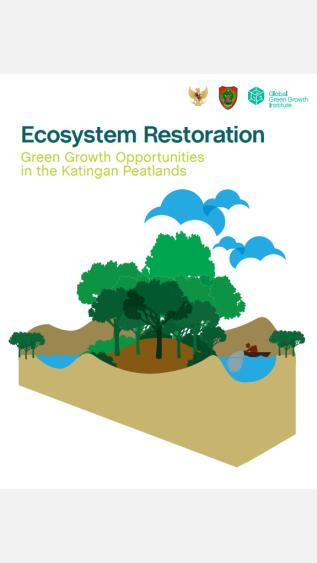
This report, Ecosystem Restoration: Green growth opportunities in the Katingan Peatlands, presents options to improve the green growth project outcomes done in the Katingan Peatlands and identifies the benefits of mitigating carbon emissions and preserving vital ecosystem services.
There is an increasing focus on the role that public and private resources can play in supporting activities that reduce forest loss as part of wider efforts to address climate change, and ensure sustainable development.