

The GGKP's first Practitioners' Workshop, "Building Pathways to Greener Growth," is taking place this week in Bogor, Indonesia. The workshop is being hosted by the Government of Indonesia and organized by the World Bank in collaboration with GIZ.
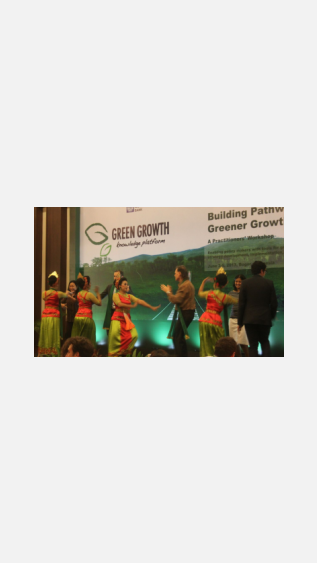
Tamaro Kane, Special Assistant to the Chief Economist for Sustainable Development at the World Bank, writes about the GGKP's first Practitioners' Workshop taking place in Indonesia this week.
By presenting a selected number of successful national experiences from 2012, the progress report illustrates the different levels at which the International Labour Organization (ILO)'s Green Jobs Programme operates. The report also provides an update on the activities which will unfold in 2013 with the continued support of the Programme’s networks and partners.
This report includes case studies on Mexico, Kenya, Thailand, South Africa, the Dominican Republic, China, Turkey, Zambia and Indonesia.
In less than a decade, clean energy transitioned from novelty products to the mainstream of world energy markets. The sector emerged not so much in a linear fashion as episodic – in fits and starts associated with the worldwide economic downturn, continent-wide debt crises, national policy uncertainty, and intense industry competition. Through it all, however, the clean energy sector moved inexorably forward, with overall investment in 2012 five times greater than it was in 2004.
Although 2012 investment levels worldwide declined 11 per cent, to US$ 269 billion, the clean energy sector weathered the withdrawal of priority incentives and initiatives offered by governments in numerous key markets, demonstrating its resilience. Reliable clean energy investment data have been collected for nine years now. Looking at the data in three-year increments, average clean energy investment increased by at least US$ 90 billion triennially – from an average of US$ 64 billion in the 2004-06 period to an average of US$ 156 billion in 2007-09 and US$ 245 billion in 2010-12.
This paper highlights the implications of the current separation of the discourses on private climate finance (PCF) and on subsidies, and the opportunities that exist to unlock climate-compatible investment by linking these fields.
Though climate finance aims to enable climate compatible development (CCD), this paper points out that, within developing countries, subsidies to fossil fuels (alone) currently dwarf any efforts toward CCD through climate finance.
Developing countries are faced with the dual challenge of reducing poverty while improving management of natural capital and mitigating the emission of greenhouse gases (GHG) and local pollutants. The challenge is particularly acute for large, rapidly growing economies, such as India, China and Brazil. In 2007 the Energy Sector Management Program (ESMAP) and the World Bank began to provide support to countries to develop long-term frameworks for reducing GHG emissions in a way that is compatible with economic growth objectives. This report presents lessons learned from seven country studies. These include: countries must take the leading role; adopt a flexible approach and build a multi-disciplinary team; stakeholder engagement and consensus building is essential; allow sufficient time and resources; and invest in data and tools. The report is intended as a practical guide for government officials, practitioners and development agencies involved in low carbon development planning.
This summary was prepared by Eldis.