
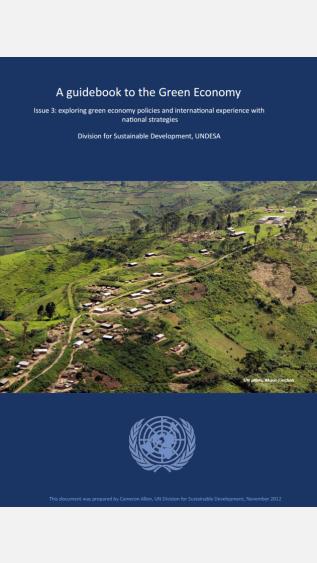
Green economy in the context of sustainable development and poverty eradication was one of two themes at the UN Conference on Sustainable Development held in Rio de Janeiro in June 2012 (or Rio+20).
Negotiations on green economy in the lead up to Rio+20 were challenging and the concept became a source of controversy and disagreement. Despite these challenges, governments agreed at Rio+20 to frame the green economy as an important tool for sustainable development; one that is inclusive and can drive economic growth, employment, and poverty eradication, whilst maintaining the healthy functioning of the Earth’s ecosystems. Importantly, the outcome document also recognises that capacity building, information exchange and experience sharing will be critical for implementing green economy policies. In this context, the document invites the UN to work with partners to provide support to developing countries and to develop toolboxes, best practices, methodologies and models to aid green economy policy design and implementation.
In order to ensure global food security and avert dangerous climate change, the world faces the pressing dual challenge of both protecting its remaining rainforests and enhancing food production in sustainable and resilient ways. Successfully achieving this would provide multiple co-benefits, including safeguarding the well-being and livelihoods of forests peoples; protecting the biodiversity and ecosystems provided by forests; and reducing rural poverty.

This report summarizes the results of a recent review of the emerging experience with the design and implementation of policy instruments to promote the development of renewable energy (RE) in a sample of six representative developing countries and transition economies ('developing countries') (World Bank 2010). The review focused mainly on price- and quantity-setting policies, but it also covered fiscal and financial incentives, as well as relevant market facilitation measures. The lessons learned were taken from the rapidly growing literature and reports that analyze and discuss RE policy instruments in the context of different types of power market structures. The analysis considered all types of grid-connected RE options except large hydropower: wind (on-shore and off-shore), solar (photovoltaic and concentrated solar power), small hydropower (SHP) (with capacities below 30 megawatts), biomass, bioelectricity (cogeneration), landfill gas, and geothermal. The six countries selected for the review included Brazil, India, Indonesia, Nicaragua, Sri Lanka, and Turkey.
As the global population heads toward 9 billion by 2050, decisions made today will lock countries into growth patterns that may or may not be sustainable in the future. Care must be taken to ensure that cities and roads, factories and farms are designed, managed, and regulated as efficiently as possible to wisely use natural resources while supporting the robust growth developing countries still need. Economic development during the next two decades cannot mirror the previous two: poverty reduction remains urgent but growth and equity can be pursued without relying on policies and practices that foul the air, water, and land.
In late 2009, Indonesia made a voluntary commitment to reduce its greenhouse gas emissions by 26 per cent by 2020, or by 41 per cent with international assistance, compared to business as usual.
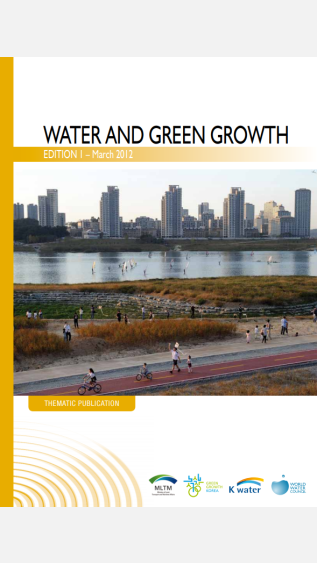
This report is the first major output of a project on Water and Green Growth, led by the Government of the Republic of Korea and the World Water Council (WWC). It is the result of over 12 months of research and analysis by an international group of experts. It provides an analysis of 26 case studies that illustrate various aspects of water and green growth, and then uses the analysis to recommend a draft framework for policymakers.