

This publication suggests solutions that can be built into the design of urban development projects undertaken by the Asian Development Bank (ADB) to address the common problems and grievances of the urban poor, and to improve urban governance overall.
It also identifies successful or promising community-based approaches to dispute resolution that can be useful in urban project design.
It uses ADB's Governance policy as a framework for analyzing key findings of Access to Justice for the Urban Poor, a regional technical assistance grant to four developing member countries in Asia and the Pacific - Bangladesh, Indonesia, the Philippines, and Thailand. The findings consist of case studies illustrating typical problems encountered by the poor in connection with access to urban assets and services, and identifies the types of grievances or disputes that may arise because of these issues. The publication reproduces key case studies to illustrate significant concepts.
Biodiversity and ecosystem services provide tangible benefits for society, such as food provisioning, water purification, genetic resources or climate regulation. These services provide critical life support functions and contribute to human health, well being and economic growth. Yet biodiversity is declining worldwide and, in some areas, this loss is accelerating. The need for policies that promote the conservation and sustainable use of biodiversity and ecosystem services is more important than ever.
Payments for Ecosystem Services (PES) is a direct and flexible incentive-based mechanism under which the user or beneficiary of an ecosystem service makes a direct payment to an individual or community whose land use decisions have an impact on the ecosystem service provision. Interest in PES has been increasing rapidly over the past decade: PES are proliferating worldwide and there are already more than 300 programmes in place today at national, regional and local levels.
Sustained growth in Brazil, China, India, Indonesia and South Africa will be critical for the global economy in the coming decades. This volume, based on the proceedings of a conference organised by the Economics Department of the OECD on 24 September 2009, analyses growth performance in these five emerging market economies and the prospects for sustaining strong growth over the longer term. Drawing on contributions from distinguished policymakers and scholars, the volume discusses the specific drivers of growth in each of the five countries with which the OECD has had a programme of Enhanced Engagement since May 2007.
This document is a review of the low carbon growth studies conducted in six emerging economies: Brazil, China, India, Indonesia, Mexico and South Africa. These countries, with the help of the Energy Sector Management Assistance Programme (ESMAP), have initiated country specific studies to assess development goals in conjunction with greenhouse gas mitigation opportunities. The aim is to present a framework for other countries who wish to implement studies of their own.
The paper is structured to mirror the seven step process of establishing a low carbon growth country study.
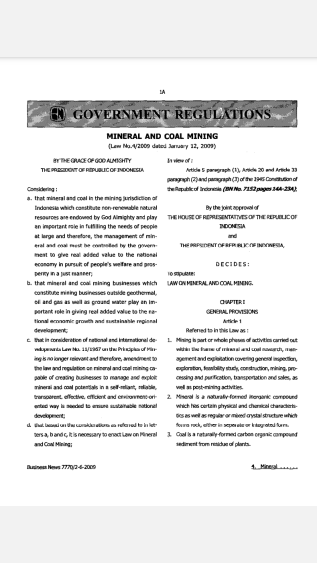
This Law provides for national policies for the management and control of mineral and coal mining and for the responsible authorities.
This report, Low Carbon Development Options for Indonesia: Status report and findings, produced by the Ministry of Finance of Indonesia in collaboration with the World Bank, puts forward a series of