

This book commences with a broad overview of Indonesia’s development since the 1960s. The analytical frameworks for the study, which were developed at Harvard University and ADB, are then used in an attempt to identify the constraints that most severely bind the country’s development, and therefore the priorities for policy implementation and/or reform. The country’s macroeconomic management and monetary policy since the Asian financial crisis is reviewed. The challenges of Indonesia’s slow industrial transformation and small industry sector are described, as are their implications for poverty reduction efforts. The challenges Indonesia faces in developing its infrastructure are set out, e.g., the country’s diverse topography, archipelagic nature, and monopolies. Human capital, an essential element in both growth and poverty reduction, is analysed for the country, including the improvements in enrolments and gender balance, and the limitations the poor face to accessing education. Indonesia’s record on poverty reduction is traced, as are the efforts to improve it.
Rapidly growing emerging economies, such as Brazil, China, India and Indonesia have joined the ranks of major industrialized countries as significant emitters of greenhouse (GHG). Their rapid economic growth has, however, brought about considerable environmental degradation, health costs, material damage, and a decrease in agriculture productivity. The notion of “green growth” has been proposed as a way out. This paper examines the case of Indonesia and evaluates its search for green growth through an approach that combines a so-called Energy Mix Policy and a REDD+ program.
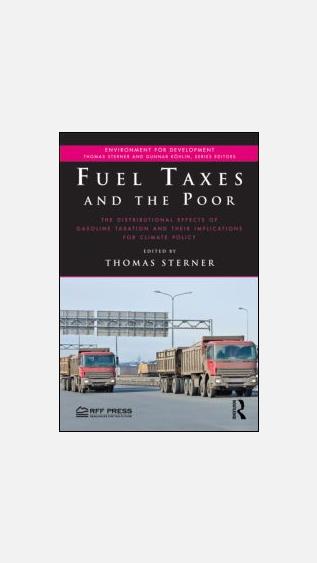
This book challenges the conventional wisdom that gasoline taxation, an important and much-debated instrument of climate policy, has a disproportionately detrimental effect on poor people. Increased fuel taxes carry the potential to mitigate carbon emissions, reduce congestion, and improve local urban environment. As such, higher gasoline taxes could prove to be a fundamental part of any climate action plan. However, they have been resisted by powerful lobbies that have persuaded people that increased fuel taxation would be regressive. Reporting on examples of over two dozen countries, this book sets out to empirically investigate this claim. The authors conclude that while there may be some slight regressivity in some high-income countries, as a general rule, fuel taxation is a progressive policy particularly in low income countries. Rich countries can correct for regressivity by cutting back on other taxes that adversely affect poor people, or by spending more money on services for the poor. Meanwhile, in low-income countries, poor people spend a very small share of their money on fuel for transport.
This volume examines the experiences of 21 developed and developing countries in adjusting their training provision to meet the new demands of a greener economy. Analysts started by identifying the drivers of transformation to a greener economy – changes in the physical environment itself and changes induced by government regulations, more efficient technologies and changes in consumer demand. Then they assessed the effect of these changes on employment, identifying areas of job growth and of job loss
Only then could researchers start to understand how skill requirements are changing and are expected to change in the future, and to examine how well national training systems are anticipating and responding to these new needs. Their analysis shows that skills development is critical to unlocking the employment potential of green growth, yet skills shortages are becoming an obstacle in realising this potential. The report recommends that countries devise strategies based on well-informed policy decisions, social dialogue, and coordination among ministries and between employers and training providers.
Climate change is one of the most pressing threats to development today. Addressing climate change requires that countries take an integrated approach to climate and development planning so that policies and actions across multiple sectors and scales facilitate the adaption to climate change and deliver poverty reduction gains. An important tool for countries to manage climate finance is the National Climate Fund (NCF). NCFs are nationally-driven and nationally-owned funds that help countries to collect climate finance from a variety of sources, coordinate them, blend them together and account for them. This guidebook is part of a series of practical guidance documents and toolkits to support national and sub-national governments to achieve low-emission, climate-resilient development. It is based on UNDP’s decades of experience in delivering climate change programming in order to help countries design and establish an NCF.
The guide presents the following as key goals of NCFs:
•collect sources of funds and direct them toward climate change activities that promote national priorities
This guide is aimed primarily at national planners and policy advisors in developing countries, focusing on the role of economic tools in planning for green growth. Some of the questions explored by the guide include: How do decision makers create a vision and strategy for green growth? What skills do planners need to work effectively with the range of green growth tools available? And how to assess which tools are right for them?
The Guide concludes that green growth planning needs to be an iterative process, adapting to local developments over time and responding to the needs of national and local stakeholders. Planners rarely find the process straightforward and rely on economic principles and tools to inform the process. However, conventional tools may not address environmental and social dimensions adequately or look beyond economic metrics. New tools and methods have emerged and existing ones have also evolved. Opening up these tools so that they’re more than a ‘black box’ and using them to obtain stakeholders’ buy-in remain key challenges.