
On November 10, 2020, the CDG Institute hosted a webinar in French reflecting on the opportunity that sustainable infrastructure brings to circular economy.
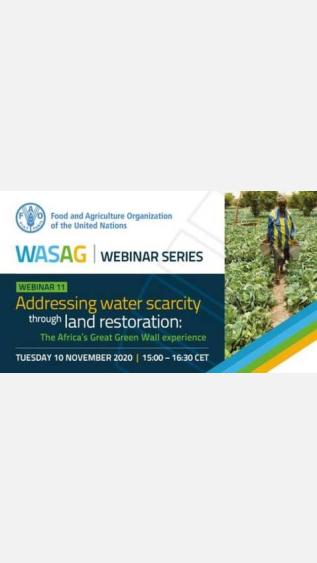
On 10 November 2020 at 15:00 (CEST), the Food and Agriculture Organization of the United Nations (FAO) is hosting a webinar on 'Addressing Water Scarcity Through Land Restoration: The Africa’s Great Green Wall experience'.
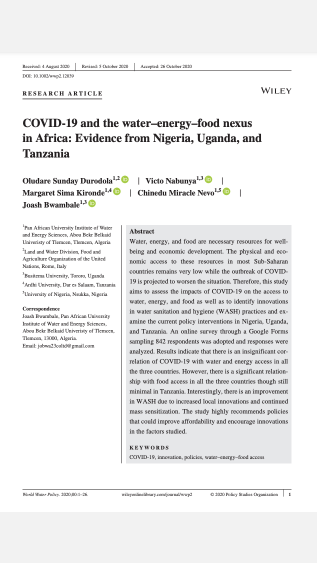
Water, energy, and food are necessary resources for wellbeing and economic development. The physical and economic access to these resources in most Sub-Saharan countries remains very low while the outbreak of COVID-19 is projected to worsen the situation.
Therefore, this study aims to assess the impacts of COVID-19 on the access to water, energy, and food as well as to identify innovations in water sanitation and hygiene (WASH) practices and examine the current policy interventions in Nigeria, Uganda, and Tanzania.
An online survey through a Google Forms sampling 842 respondents was adopted and responses were analyzed. Results indicate that there is an insignificant correlation of COVID-19 with water and energy access in all the three countries. However, there is a significant relationship with food access in all the three countries though still minimal in Tanzania. Interestingly, there is an improvement in WASH due to increased local innovations and continued mass sensitization. The study highly recommends policies that could improve affordability and encourage innovations in the factors studied.

There are several mechanisms that promote the funding of renewable energy (RE) and energy efficiency (EE) solutions. Following discussions with various financiers (commercial, alternative, developmental and governmental), this guideline unpacks the elements and factors considered by funders of RE and EE projects in South Africa.
Tourism increasingly plays a central role in Uganda’s economy, while featuring strongly in COVID-19 recovery responses. The tourism sector offers opportunities to generate income and jobs while protecting Uganda’s vast wildlife and biodiversity, and strengthening cultural heritage.
The main objective of this report is to understand how a variety of developing and emerging economies are successfully utilizing horizontal integration—across multiple infrastructure sectors and systems—at the metropolitan scale to deliver greater sustainability. This report explores how integrated planning processes extending well beyond city boundaries have been financed and implemented in a diverse group of metropolitan areas.