
This policy brief summarizes the use of the innovative integrated economic and environmental model (IEEM) coupled with land use land cover (LULC), and ecosystem service models (IEEM+ESM) to understand how various policy interventions can affect economic, poverty amelioration, and environmental outcomes in Rwanda.
This study utilizes an innovative integrated economic and environmental model (IEEM) coupled with land use land cover (LULC), and ecosystem service models (IEEM+ESM) to understand how various policy interventions could affect economic, poverty amelioration and environmental outcomes in Rwanda.
This document highlights IUCN’s efforts in Eastern and Southern Africa, working with governments, members, communities and partners to embed environmental considerations into their responses to COVID-19.
This report reviews South Africa’s industrial policy, from an inclusive green economy lens. It investigates the extent to which South Africa’s industrial policy is responding to, if not driving, the country’s transition. Building on this analysis, recommendations to foster green industrial development in South Africa can be formulated. They are split into four complementary components: capacity building; policy mainstreaming; information/data systems; and transition planning.
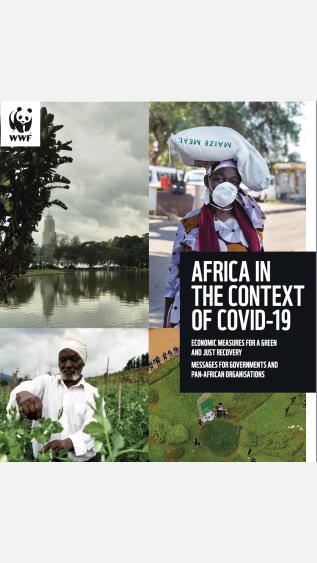
This paper presents an argument that a Green and Just recovery is the only truly resilient option for Africa that directly addresses the key challenges surfaced by the pandemic and offers an opportunity for sustainable growth.
This working paper examines case studies of three communities in Bhutan, Ethiopia and Costa Rica that are already experiencing severe impacts of climate change.