
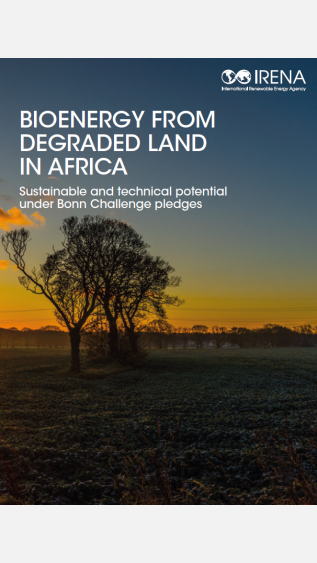
Restoration of degraded land can create vast bioenergy crop potential, without constraining food crops or other land use options. This presents an important opportunity for African countries to develop modern, sustainable bioenergy from rapidly growing wood crops at the same time as pursuing ambitious forest landscape restoration initiatives.
Bioenergy from Degraded Land in Africa: Sustainable and technical potential under Bonn Challenge pledges presents a methodology to estimate the sustainable energy potential from land restoration in line with the Bonn Challenge, particularly as it relates to African countries. (The Bonn Challenge is a global effort to bring 150 million hectares of the world’s deforested and degraded land into restoration by 2020, and 350 million hectares by 2030.)
The African Forest Landscape Restoration initiative, AFR100, has set out to collect pledges to restore 100 million hectares of degraded land, mostly in in sub-Saharan Africa. To date, 18 countries have pledged to restore 75 million hectares.
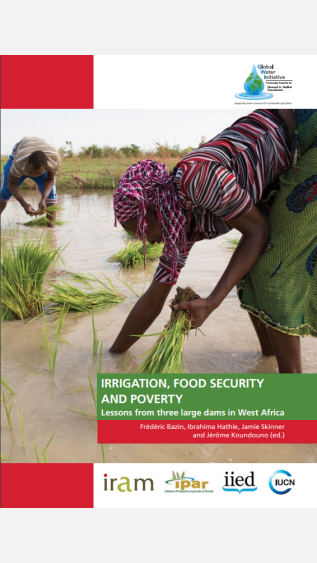
This report presents field evidence from three major public financing schemes for large-scale rice irrigation in West Africa. The report assesses the cost-effectiveness of the schemes, the quality of their management, and the persistence of poverty and food insecurity. It shows that answering questions including, “what type of farmers get the best results?”, “how big should plot sizes be and with what tenure conditions?” and “what credit and marketing systems would support farmers effectively?” are needed if production is to be sustainably improved.
The report aims to help decision makers understand project outcomes and optimize the returns on State investment, both for the taxpayer and for individual farmers. It makes recommendations for action and for the better alignment of public policy objectives with the interests of a diverse set of smallholder farmers, from making better use of existing systems to improving the design of future projects.
The paper Increasing the Value of Climate Finance in An Uncertain Environment: Diaspora Financial Resources as a Source of Climate Finance for Sub-Saharan Africa undertook an analysis of project reports, policy reviews, policy briefs, and academic literature reviews on the barriers and opportunities for private investments in climate change programmes.
Quantitative country studies on the potential of investing in a green economy were conducted between 2013 and 2016 in eight African countries, namely, South Africa, Burkina Faso, Ghana, Mauritius , Kenya, Mozambique, Rwanda and Senegal.
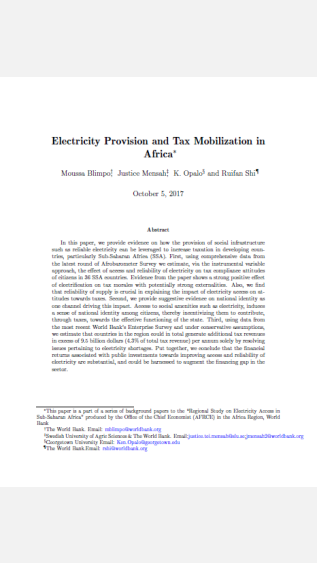
In this paper, the authors provide evidence on how the provision of social infrastructure such as reliable electricity can be leveraged to increase taxation in developing countries, particularly Sub-Saharan Africa (SSA). First, using comprehensive data from the latest round of Afrobarometer Survey the authors estimate, via the instrumental variable approach, the effect of access and reliability of electricity on tax compliance attitudes of citizens in 36 SSA countries. Evidence from the paper shows a strong positive effect of electrification on tax morales with potentially strong externalities. Also, it is found that reliability of supply is crucial in explaining the impact of electricity access on attitudes towards taxes. Second, suggestive evidence on national identity as one channel driving this impact is provided. Access to social amenities such as electricity, induces a sense of national identity among citizens, thereby incentivizing them to contribute, through taxes, towards the effective functioning of the state.
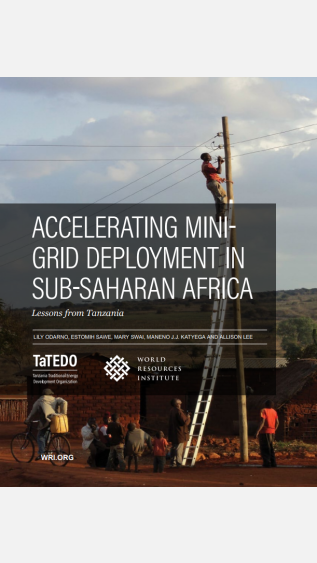
The report Accelerating Mini-grid Deployment in Sub-Saharan Africa: Lessons from Tanzania is the first major survey of Tanzania’s mini-grid sector.