
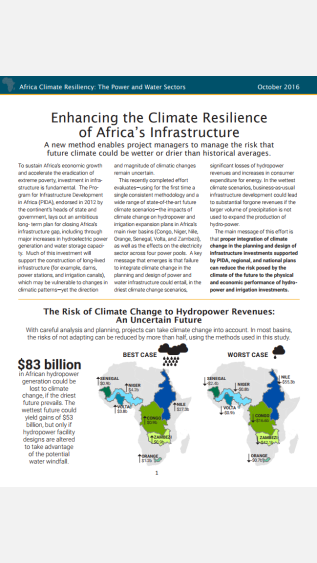
To sustain Africa’s economic growth and accelerate the eradication of extreme poverty, investment in infrastructure is fundamental. The Program for Infrastructure Development in Africa (PIDA), endorsed in 2012 by the continent’s heads of state and government, lays out an ambitious long- term plan for closing Africa’s infrastructure gap, including through major increases in hydroelectric power generation and water storage capacity. Much of this investment will support the construction of long-lived infrastructure (for example, dams, power stations, and irrigation canals), which may be vulnerable to changes in climatic patterns—yet the direction and magnitude of climatic changes remain uncertain. This recently completed effort evaluates—using for the first time a single consistent methodology and a wide range of state-of-the-art future climate scenarios—the impacts of climate change on hydropower and irrigation expansion plans in Africa’s main river basins (Congo, Niger, Nile, Orange, Senegal, Volta, and Zambezi), as well as the effects on the electricity sector across four power pools.
This policy brief draws on the findings from the report and makes an economic case for investing in ENRs to reduce poverty within the context of what is generally known as the ‘poverty-environment nexus.’
High upfront costs and investment risks constitute critical barriers for investments in low-carbon infrastructure technologies in the Middle East and North Africa. This article uses a case study of Morocco's solar strategy for the electricity sector in order to explore how domestic versus regional/multilateral governance structures impact upon the downside risk of clean energy investments and translate into lower financing costs. The authors firstly process-trace the differential effects of governance on policy and financial de-risking, intended as risk reduction and risk transfer. Then they quantify the impact of policy and financial de-risking on the financing costs of the Ouarzazate CSP Noor 1 project.
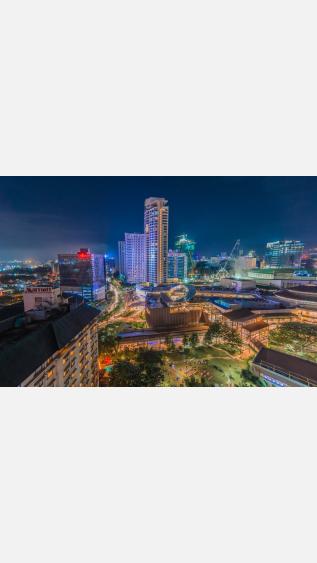
Africa is urbanising fast. By the mid-2030s, a majority of Africans will live in urban areas. But productive jobs and quality public services are not keeping up with the fast growth of cities and towns. Yet urbanisation holds huge potential for accelerating economic, social and environmental development; even rural areas would benefit from the development of vibrant, sustainable African cities.
The inclusive green economy has gained considerable attention in past years as an action-oriented approach and one of the tools for realizing sustainable development. The main contribution of this approach has been identified as integrating economic, social and environmental dimensions of development policies in a coherent, cross-sectoral framework of analysis. As governments begin to develop and implement inclusive green-economy strategies, more attention is being given to research into the use of methodologies and tools to identify social, economic and environmental trends, and the evaluation of the likely outcomes of implementing inclusive green economy policy.
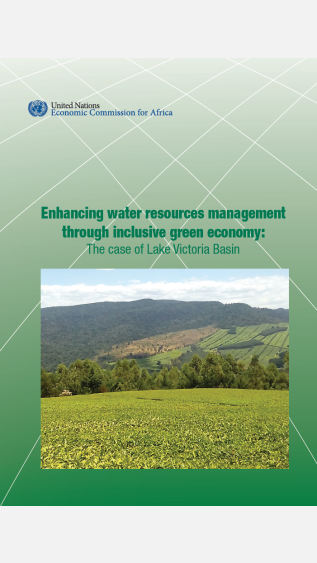
Lake Victoria in East Africa, the world’s second largest lake, is endowed with abundant water and other natural resources. The lake is transboundary and of significance to its basin countries – which are also East African Community (EAC) partner States (Burundi, Kenya, Rwanda, Uganda and United Republic of Tanzania) – and basin communities because of its role in supporting valuable ecosystem services, livelihood systems and economic activities. The basin’s natural resource endowments include water resources (the lake’s estimated volume is 2,700 km3); rivers, streams and wetlands; abundant and fertile land; natural forest resources; minerals; and wildlife, including a high annual fish yield estimated at more than $550 million. It also hosts the crested crane and the globally threatened sitatunga – a swamp dwelling antelope.