

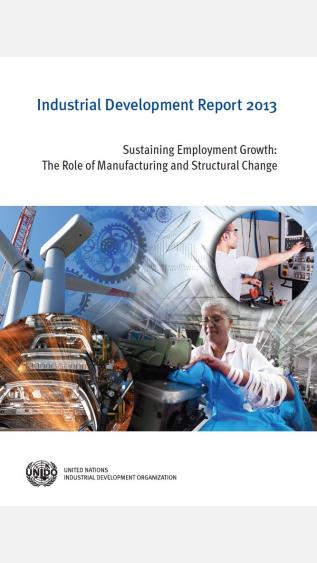
The Industrial Development Report 2013 examines the role of structural change and employment and explores the underlying drivers of structural change in manufacturing. While manufacturing employment is growing in developing countries, its decrease in developed countries is being mitigated by the rise in manufacturing-related services employment. The food and beverages and textiles and garments industries offer least developed countries tremendous potential for industrialization, whereas high-tech industries hold numerous opportunities for developed countries to invest and innovate and to thus sustain jobs. The impact of the critical drivers of structural change and industrialization—namely costs, technology, demand and resource efficiency—to sustain employment hinges on the industrial policies adopted. These must therefore be geared towards the structural transformation of the economy and will only be effective if the policy-making process plays as important a role as the policy content.
This paper presents a new research agenda on climate change and green growth from the perspective of the division of labor in classical economics. The paper covers three major dimensions of green growth (i.e. carbon emissions, environmental protection and material resources use) and some related important topics, as well as the fresh policy implications of the new research agenda. Typical marginal analysis in a given structure of the division of labor suggests that “green” action is a burden to economic development. Therefore, climate negotiation has become a burden-sharing game and has reached a stalemate. New thinking is badly needed to rescue these negotiations and to drive a shift to a new “green growth” paradigm. The proposed new research agenda represents an effort to create a new narrative on climate change and green growth. Because the new research agenda can theoretically predict the possibility that a more competitive structure of the division of labor could be triggered by “green” policy, it has promising policy implications for various important challenges facing us in the 21st century.
Green growth cannot succeed without significant changes in the education system and the closely related social division of labor. This paper combines historical evidence and a game-theoretic analysis to study the relation between vocational education and green growth. It is found that a low-vocation and a high-vocation equilibrium can be distinguished in the interplay between education and labor markets, and that a high-vocation equilibrium is better suited for green growth. At the present stage of development, there are tendencies in both directions in China. Therefore, China has the possibility to successfully implement a green growth strategy by developing a strong vocational education with Chinese characteristics.
The paper appears in the Special Issue: Climate Change and Green Growth: New Thinking.
Green growth is a relatively new concept aimed at focusing attention on achieving sustainable development through the efficient use of environmental assets without slowing economic growth. This paper presents a real-world application of the concept, and identifies viable policy options for achieving a complementary environmental regulatory framework that minimizes output and employment losses. The analysis utilizes macro level data from the Turkish economy, and develops an applied general equilibrium model to assess the impact of a selected number of green policy instruments and public policy intervention mechanisms, including market-based incentives designed to accelerate technology adoption and achieve higher employment and sustainable growth patterns.
The Business Innovation Facility (BIF) has piloted an approach to provide advice and technical assistance to deliver innovative solutions and practical strategies that can get business models off the ground.