
This landmark report Clean Innovation lists six key recommendations to accelerate innovation for a stronger, cleaner economy that benefits all Canadians.
The role of technology transfer in the mitigation of climate change has been strongly emphasized in the recent policy debate. This paper Technology Diffusion and Climate Policy: A Network Approach and its Application to Wind Energy offers a network-based perspective on the issue.
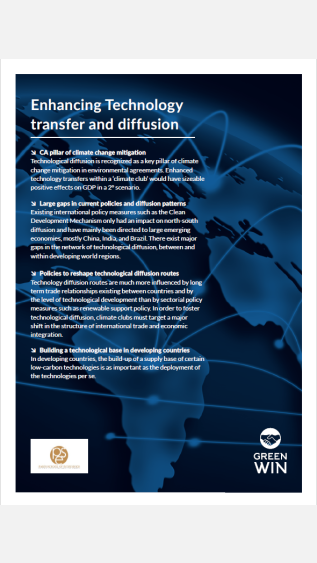
Technological diffusion is recognized as a key pillar of climate change mitigation in environmental agreements. This policy brief, Enhancing Technology Transfer and Diffusion, published as part of the Green-Win project, finds that enhanced technology transfers within a ‘climate club’ would have sizeable positive effects on GDP in a 2° scenario. Existing international policy measures such as the Clean Development Mechanism only had an impact on north-south diffusion and have mainly been directed to large emerging economies, mostly China, India, and Brazil. There exist major gaps in the network of technological diffusion, between and within developing world regions. Technology diffusion routes are much more influenced by long-term trade relationships existing between countries and by the level of technological development than by sectorial policy measures such as renewable support policy. In order to foster technological diffusion, climate clubs must target a major shift in the structure of international trade and economic integration.
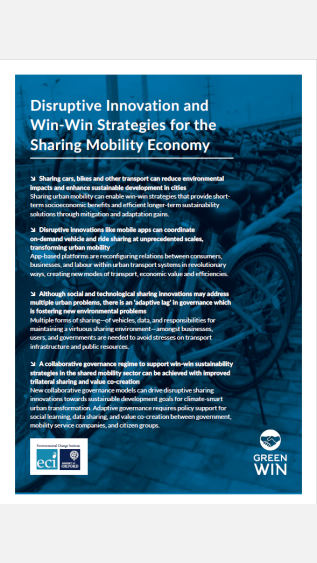
This policy brief, Disruptive Innovation and Win-Win Strategies for the Sharing Mobility Economy, published as part of the Green-Win project provides insights into the disruptive innovation of the sharing economy which is occurring in the urban mobility sector. Sharing mobility promotes win-win strategies that aim to provide short-term socioeconomic benefits and longer-term environmental impacts through mitigation and adaptation gains and therefore to enhance sustainable development in cities. Disruptive innovations, like mobile apps can coordinate on-demand vehicle and ride sharing at unprecedented scales, transforming urban mobility. Although social and technological sharing innovations may address multiple urban problems, there is an ‘adaptive lag’ in governance which is fostering new environmental problems. A collaborative governance regime to support win-win sustainability strategies in the shared mobility sector is needed between mobility companies, users and the public, and city governments. The analysis is illustrated through examples investigated in the Green-Win project.

The transition to a low carbon economy is a capital-intensive process requiring large scale finance combined with suitable low-carbon investment projects. There is no shortage of capital available globally – the financial sector encompasses more than EUR 100 trillion of assets globally – but several factors inhibit the expansion of private finance in low-carbon investment.
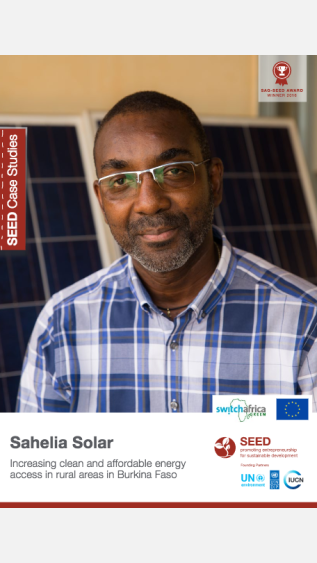
Sahelia Solar is an eco-inclusive enterprise located in Ouagadougou, the capital of Burkina Faso, and specialises in the design and supply of a range of solar energy systems.