
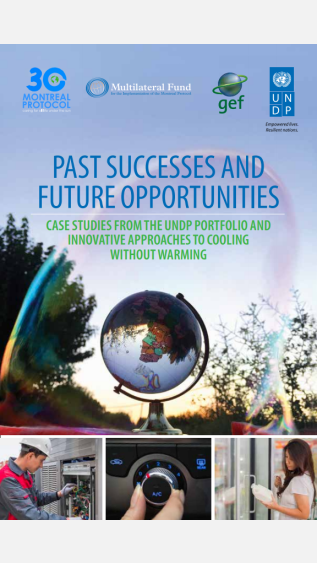
The brochure Past Successes and Future Opportunities covers examples of UNDP’s work in protecting the global ozone layer, advancing sustainable cooling solutions for and tackling climate change, and highlighting linkages to the Sustainable Development Goals.

The role of technology transfer in the mitigation of climate change has been strongly emphasized in the recent policy debate. This paper, Technology Diffusion and Climate Policy: A Network Approach and its Application to Wind Energy, offers a network-based perspective on the issue.
As a prelude to scaled-up deployment of electric vehicles, this paper examines the economic feasibility of replacing the current fleet of fossil fuel taxis in Seoul with electric vehicle (EV) taxis by phasing the former out based on their opertional lifetime. In the cost-benefit analysis for such a transition, costs of purchasing vehicles and constructing and maintaining charging infrastructure are estimated based on the market prices and characteristics of taxi transport in Seoul. On the benefit side, the avoided environmental costs due to reduced air pollutants and greenhouse gas emissions are calculated. The transport planning model, especially traffic assignment, is incorporated in the calculation process for a better estimation of the avoided costs through more accurate link flows and speeds on the road network. Savings from the fuel switch to electricity from liquefied petroleum gas for taxis are also estimated. The resultant benefit-cost ratio signifies economic viability of the deployment of EV taxis. The results of the study are encouraging and could be a good piece of rationale to push forward with electric vehicles.
Chinese transport activity has grown rapidly in recent years, and curbing CO2 emissions from this sector is a major challenge. This paper investigates the potentials offered by both technological solutions and changes in infrastructure deployment strategy that can address this challenge. The research is carried out by using the IMACLIM-R energy-economy-environment (E3) model which includes a detailed description of passenger and freight transportation dynamics. The standard representation of transport technologies is supplemented with an explicit representation of the “behavioral” determinants of mobility. Although they drive transport demand, these determinants are often disregarded in mitigation assessments. This framework considers (i) the spatial organization of housing and production, (ii) modal choices induced by transport infrastructures and (iii) the freight transport intensity of production and distribution processes.
In this paper, Demand for Off-grid Solar Electricity: Experimental Evidence from Rwanda, reveals willingness to pay for different off-grid solar technologies in Rwanda.
The paper The Role of Digital Payments in Sustainable Agriculture and Food Security examines how a shift to digital payments can provide powerful solutions that help countries improve agricultural productivity and ensure food security.