
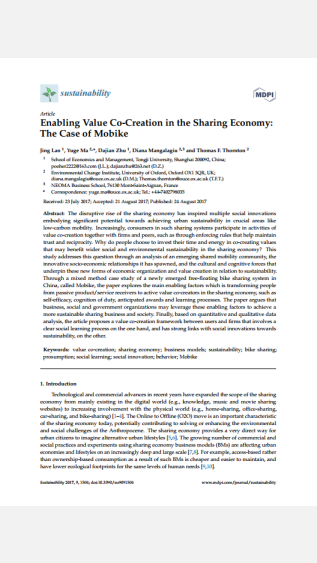
The disruptive rise of the sharing economy has inspired multiple social innovations embodying significant potential towards achieving urban sustainability in crucial areas like low-carbon mobility. Increasingly, consumers in such sharing systems participate in activities of value co-creation together with firms and peers, such as through enforcing rules that help maintain trust and reciprocity. Why do people choose to invest their time and energy in co-creating values that may benefit wider social and environmental sustainability in the sharing economy?
The working paper Synergies between Renewable Energy and Energy Efficiency considers how renewables and energy efficiency can work together to contribute to global energy decarbonisation by 2050.
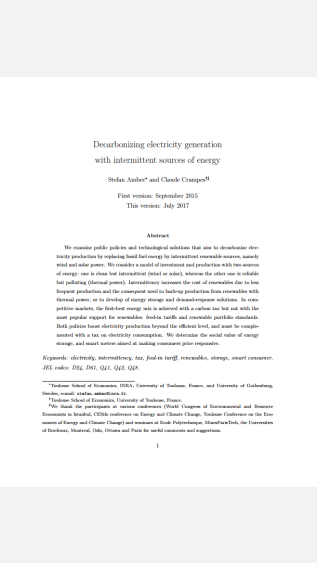
The paper Decarbonizing Electricity Generation with Intermittent Sources of Energy examines public policies and technological solutions that aim to decarbonize electricity production by replacing fossil fuel energy by intermittent renewable sources, namelywind and solar power.
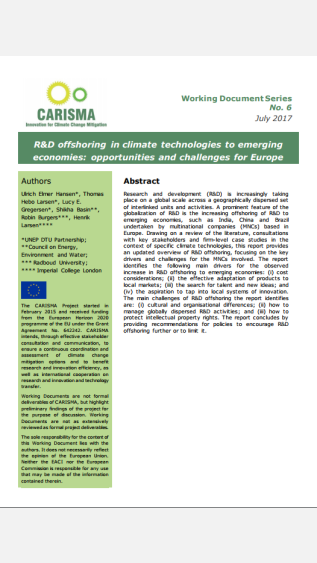
The CARISMA Project started in February 2015 and intends, through effective stakeholder consultation and communication, to ensure a continuous coordination and assessment of climate change mitigation options and to benefit research and innovation efficiency, as well as international cooperation on research and innovation and technology transfer.
The world needs a decarbonised energy sector by the second half of the century. In many energy applications, the necessary technologies are available today, so the important next step is the development of enabling policy frameworks in place to scale up their deployment. There are however energy demands in end-use sectors that are responsible for a third of the emissions in the Reference Case in 2050 – the baseline of this study, where several technology options are emerging but are yet to reach their economic and technical viability.
This working paper aims to shed light on the conditions needed to nurture low-carbon technology innovation. By assessing current status and future needs for such technologies, it seeks to identify the elements of a flexible policy framework for innovation, broadly suitable to enable decarbonisation of the energy sector between now and 2050. The envisaged of cultivation of effective, case-specific innovation policies would do much to help countries meet international climate goals, such as those set forth in the 2015 Paris Agreement.

The Global Cleantech Innovation Index (GCII) programme investigates where, relative to GDP, entrepreneurial clean technology companies are most likely to emerge from over the next 10 years – and why. Drawing on a wide range of factors and sources, the study "The Global Cleantech Innovation Index 2017: Which countries look set to produce the next generation of start-ups?" seeks to answer the same question as the 2012 and 2014 GCII reports, namely: which countries currently have the greatest potential to produce entrepreneurial cleantech start-up companies that will commercialize clean technology innovations over the next 10 years? Based on the data contributing to 15 indicators of creation, commercialisation and growth of cleantech start-ups in 40 countries, the study identifies different key trends and shows which countries are falling ahead and below the curve for cleantech innovation.