
The latest issue of “Green Growth the Nordic Way” is published in connection with the pre-COP21 event World Efficiency in Paris, October 13-15.

Addressing climate change requires urgent policy action to drive a global infrastructure and technological transformation. More countries are implementing core climate policies but still a number of obstacles stand in the way of effective change.
This study comprehensively examines the manufacturing supply chain of different components used in RE (renewable energy) systems, especially wind and solar technology, in India. Over the past one and half years, around 90 interviews were conducted across the solar and wind industry comprising manufacturers, developers, system integrators, academicians and policy makers. A sourcing strategy for these components has been identified based on macroeconomic criteria, material and resource constraints, techno-economic feasibility and international market dynamics. The report also proposes necessary policy and regulatory interventions to expand the supply of RE and create a demand-side pull.
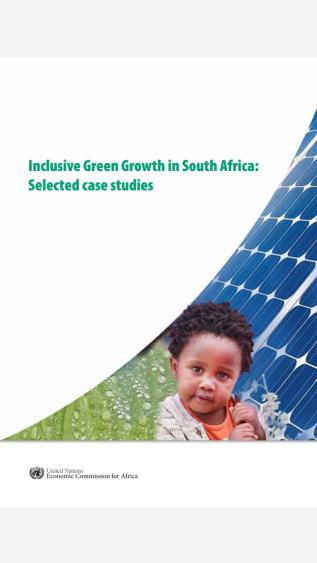
The main objective of the present report is to document good practices and lessons learned on inclusive green growth from selected case studies in South Africa.
Globally, new forms of electromobility are challenging established transport technologies based on internal combustion engines. The authors explore how this transition is simultaneously unfolding in four countries, enabling them to shed some light on the dynamics and determinants of technological path creation. The paper's analysis covers two old industrialized countries (France and Germany) and two newly industrialized countries (China and India) with very different market conditions and policy frameworks. It reveals enormously different choices of technologies and business models and traces them back to four main drivers of divergence: technological capabilities, demand conditions, political priorities and economic governance.
This report presents the conclusions of the independent expert group on the 'Follow-up to Rio+20, notably the sustainable development goals (SDGs)' that was established by the European Commission (EC) to provide advice on the role of science, technology and innovation (STI) for implementing the new global sustainable development agenda (2030 Agenda). The group gives recommendations, both in terms of general policy orientations and concrete areas of engagement, for EU STI policy to contribute to the implementation of the 2030 Agenda in Europe and beyond, as well as for possible engagement in international initiatives concerning STI. It recommends the EU to capitalise on its Horizon 2020 research and innovation programme, which is seeking to invest more than 60% of its budget for sustainable development and is fully open to international participation.