
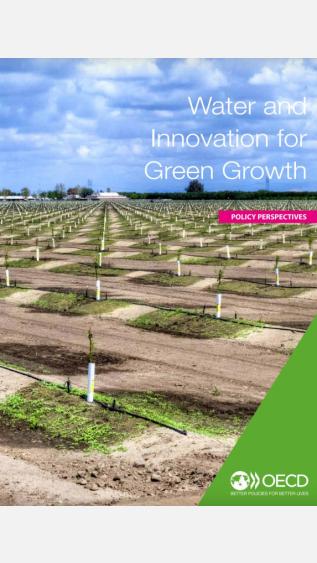
Effective water management is a crucial ingredient for green growth. It is becoming increasingly clear that astute investment in, and management of, water can help to drive green growth. To do this, governments must catalyse water-related investment and innovation that underspin sustained green growth and give rise to new economic opportunities. Drawing on recent OECD work on policies to support green growth, and on water economics and governance, this Policy Perspectives brochure lays out the opportunities to manage and invest in water as a means for green growth. This paper identifies the key policy options that governments can use to assist this transition towards greener growth.

The Europe 2020 Strategy has identified the key goal of smart, more inclusive and sustainable growth. In this direction, redirecting firms’ innovation activities towards ecological targets without hampering their competitiveness is of paramount importance. The double externality issue related to environmental innovations makes the policy intervention crucial in order to avoid sub-optimal commitment of resources to the innovation process and ensure the reduction of polluting agents emissions.
2iE and the Ministry of Mining and Energy of Burkina Faso in partnership with The University of Ouagadougou and the University of Perpignan are holding the 2nd edition of AFRICASOLAR, the international gathering of solar power stakeholders in Africa. For the event there is also the announement of a call for papers.
This report provides an introduction to the analysis of innovation systems as they relate to green growth. It reviews the basic elements of innovation systems theory; outlines various levels of analysis including the benefits and drawbacks of each approach; describes the main elements needed to build and analyze innovation systems; and provides guidance on how to assess the functioning of an innovation system and recommendations to improve it.
This paper presents novel empirical evidence on the internationalization of green R&D by multinational firms (MNCs), as measured by patents data. Using data on inventors’ addresses for the set of 1200 MNCs firms patenting in green technologies over the 2004–2009 period, it was found that about 17% of green patents result from MNCs R&D investments conducted outside their home countries. MNCs tend to locate their foreign green R&D activities in other OECD markets and in China, in particular in lightings and solar technologies. The empirical analysis reveals that the probability of conducting green R&D abroad increases with the host country’s stringency of environmental regulation, market size and (green) R&D intensity. Also, relatively lower wages for scientists and engineers, and stronger protection for intellectual property rights in the host country increase the likelihood for MNCs to offshore green R&D. The paper concludes by discussing the policy implications of this changing global innovation landscape.
The Korean government adopted “green growth” in 2008 as an environmentally friendly growth strategy. The energy efficiency of Korea, however, is still relatively low due to the large portion of energy intensive industry (EII) in its manufacturing sector. To improve energy efficiency in Korea, from an EII perspective a new approach has to be taken because restructuring entire industries would take too much time and be too costly. This study aims to emphasize the importance of innovation and analyze the effects of R&D on product and process innovations in EII in Korea. The Probit model is adopted to estimate the effects of eight determinants in the Korea Innovation Survey 2008 data. The results of this study demonstrate that one of the most important determinants, the R&D personnel ratio, has a strong positive effect on both product and process innovation, while another determinant, R&D intensity, only has a strong and positive effect on process innovation in EII. Because of the resulting innovation, energy policies should be enacted to enhance energy efficiency.