

Written by the research team of at the Institute for Labor Studies, Ministry of Human Resources and Social Security, China, this study presents both the current situation and potential for green employment in China, as well as results of surveys conducted in eight companies in the power industry. In China, green employment can be defined as work in industries, sectors, enterprises, and positions which have low input, high output, low consumption, low emissions, recyclability and sustainability. The purpose of the study is to make policy recommendations for China’s transition toward green employment.
This National Energy Policy outlines the Government of Ghana’s policy direction regarding the current challenges facing the energy sector.
This report provides recommendations to develop and implement policy reforms supporting market formation and fostering a favorable climate for investments in the sectors of energy efficiency and renewable energy sources. This wide-ranging regional assessment is based on case studies, expert workshops and senior policy maker seminars. It encourages policy makers to focus on: “quick wins” to demonstrate rapid results and increase political support through those measures that can be introduced in less than a year and are likely to produce significant impact at moderate costs; “essentials” as the backbone of a comprehensive energy efficiency and renewable energy policy, affecting the areas of great
This report describes the programme framework of the Poverty-Environment Initiative (PEI) in Nepal, which has the overall goal to support poverty reduction and inclusive development by integrating climate and environmental concerns and opportunities of the poor into development planning and economic-decision making.
The report Poverty-Environment Initiative (PEI) Nepal Programme Framework entails Nepal's situation analysis that is expected to help PEI's objectives to integrate climate change and environmental aspects into national and local level planning. It includes key outputs and activities carried out by PEI to integrate pro-poor environmental measures in national planning, budgeting, and monitoring processes.
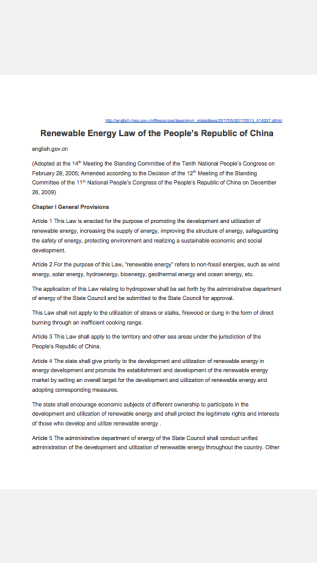
Renewable Energy Law of the People's Republic of China was adopted on 28th February 2005 and was amended on December 26th, 2009. The law was formulated to promote the development and utilization of renewable energy, to increase the supply of energy and to protect the environment in order to realize sustainable development. The renewable energy here refers to non-fossil energies, such as wind energy, solar energy, hydro energy, bioenergy, geothermal energy, and ocean energy.