
This report published by the International Renewable Energy Agency (IRENA) presents its findings upon the newly installed renewable power capacity.
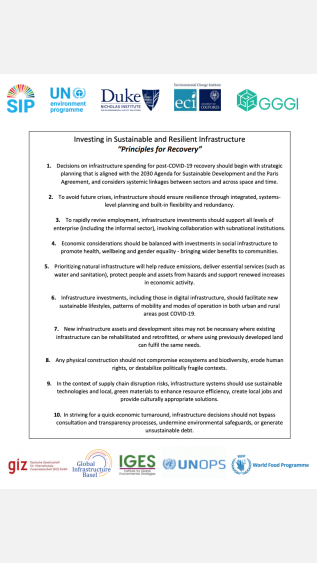
These 10 principles provide a framework for decision-making on infrastructure spending for post-COVID-19 recovery and stimulus packages.

On 27 May 2020, 16:00 (CEST), OECD Green Talks Live is hosting a webinar on 'Financing Water Services in Europe now and in the future: Needs and capabilities'.

The UN Economic and Social Commission for Asia and the Pacific (ESCAP) has announced a four-city pilot of a project to make plastic waste management more “circular” and reduce plastic pollution of the marine environment. ESCAP's ‘Closing the Loop’ project is supported by the Government of Japan. It will help to build the capacity of ASEAN cities to plan for and manage their plastic waste using circular economy principles. The pilot cities are: Kuala Lumpur, Malaysia; Surabaya, Indonesia; Nakhon Si Thammarat, Thailand and Da Nang, Viet Nam.

While carbon pricing and sustainable financing are important tools to combatting climate change, investing in clean energy technologies are the best way to achieving net-zero carbon emissions. The move to achieving net-zero carbon emissions must happen as quickly as possible and at scale to combat climate change. To achieve real, quantifiable impacts, we must explore and invest in all possible policy solutions, among them carbon pricing, sustainable finance and the promotion of clean energy technology.

As China emerges from the coronavirus crisis, the government is assessing the opportunities and challenges as it looking to further invest in ICT and other digital technologies as part of the country’s recovery efforts.